
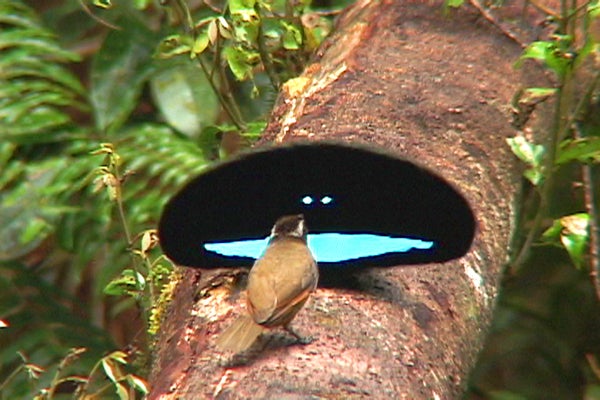
Many male birds-of-paradise employ bright colors and iridescent feathers in their mating displays—but a few species also sport superblack plumage. Now researchers have teased out the structural secrets behind these feathers, which rival even the deep, velvety darkness of human-made materials designed to absorb light.
Feathers, like most opaque objects, typically get their color from pigments in surface coatings (much as melanin colors skin) or from tiny surface structures that reflect light, such as those found on iridescent butterflies and beetles. But superblack feathers are the opposite of iridescent, says Dakota McCoy, an evolutionary biologist at Harvard University and co-author of a recent study on the topic. This plumage absorbs up to 99.95 percent of the visible light that hits it, reported McCoy and her colleagues in January in Nature Communications.
A closer look at these specialized display feathers exposes their light-trapping trick: microstructures called barbules, located near the feathers' tips, are covered with a multitude of even tinier branching structures. In contrast, most flight-feather barbules have Velcro-like hooks that can snag neighboring barbules to form a solid yet flexible aerodynamic surface. When light strikes a superblack feather's forest of barbules—which tilt at about 30 degrees toward the outer tip of the feather—it gets reflected into cavities between the tiny structures rather than outward, McCoy says. Even when coated with vaporized gold, these feathers still appeared black, whereas feathers that derive their black color from pigments looked golden when similarly coated, she adds.
On supporting science journalism
If you're enjoying this article, consider supporting our award-winning journalism by subscribing. By purchasing a subscription you are helping to ensure the future of impactful stories about the discoveries and ideas shaping our world today.
.jpg?w=1350)
The super-black feathers of the bird-of-paradise Parotia wahnesi get their light-absorbing ability from tiny barbules on their plumes. Credit: Dakota McCoy
The team's findings reveal a new type of feather microstructure, according to evolutionary biologist Matthew Shawkey of Ghent University in Belgium, who was not involved in the study. “This structure enhances the blackness produced by the feathers' pigments,” Shawkey says.
Black feathers found on other birds-of-paradise—and some found elsewhere on one of the species the team analyzed—reflect between 10 and 100 times more light than the superblack feathers do, McCoy says.
She and her colleagues propose that the inky feathers evolved as a way to emphasize brighter-colored ones, helping to attract potential mates. In all the superblack species the researchers examined, the special feathers were always immediately adjacent to bright, lustrous ones. During mating displays the males hold these plumes so that the feathers appear their darkest from the females' point of view, McCoy notes.
“This is definitely not about camouflage,” Shawkey says. “This superblack plumage is enhancing the contrast with those bright-colored feathers nearby.”