
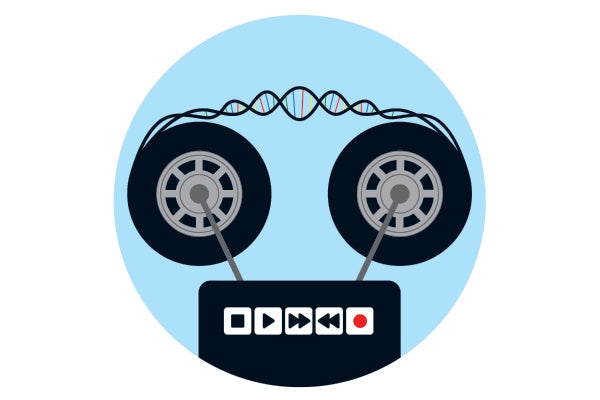
CRISPR is best known as being the basis of a powerful gene-editing tool. But first and foremost, it is a defense that bacteria use against viruses. Inspired by this delicate natural system, researchers have now created another scientific application for it—a tiny “tape recorder” that chronicles biological signals on strands of a bacterium’s DNA.
The investigators believe this microbial recorder could eventually be used for sensing abnormalities in bodily functions such as digestion, for measuring pollutant levels in oceans or for detecting nutrient changes in soil. It works much like the natural CRISPR system in many bacteria and other single-cell organisms, except for the signals it detects.
CRISPR is a DNA sequence that makes and keeps a genetic record of viruses the bacterium encounters, commanding it to kill any that try to reinfect the bacterium or its descendants. Whereas the natural CRISPR system remembers viral DNA, the new application can track a variety of biochemical signals. For example, these bacterial recorders could detect the presence of the sugar fucose in a human’s gut, indicating an infection.
On supporting science journalism
If you're enjoying this article, consider supporting our award-winning journalism by subscribing. By purchasing a subscription you are helping to ensure the future of impactful stories about the discoveries and ideas shaping our world today.
When the bacterium senses a specified signal, it creates many copies of what is called trigger DNA, which then get recorded on one end of its genetic “tape.” The tape continues to record in the absence of the designated signal, registering the “background noise” of other pieces of DNA sloshing around in the cells. These background signals serve as time stamps on the recordings. Scientists at Columbia University reported the findings in a study published in December 2017 in the journal Science.
The researchers suggest that a few million bacteria that are outfitted with copies of this tool could be deployed in the human body or the environment, where they would passively record until they are recovered from feces or soil samples and the tapes can be read. Unlike most previous biological memory systems, this one is fully under the bacterial cells’ control.
“The DNA is writing itself in response to changes in the environment, whereas in the prior work you sort of had a puppeteer showing that the DNA could be written—but somebody was pulling the strings,” says Drew Endy, a synthetic biologist at Stanford University, who was not part of the study.
Although this technique has been tested only in the laboratory, the team showed it could continuously record three different signals in a population of Escherichia coli cells for three consecutive days.
Recording ability decreased with time, probably because operating as a tape recorder does not confer any survival benefits, Endy says. He also notes that the signal needs to be present for six hours for the tool to reliably record it, which may be too long to detect fleeting signals. Harris Wang, a synthetic biologist at Columbia and senior researcher on the study, hopes to speed that process up in future work.