
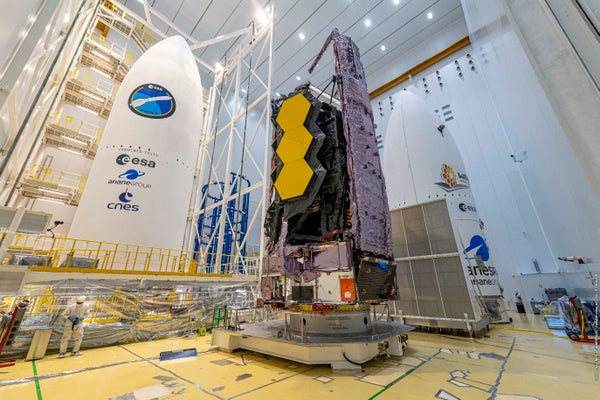
NASA’s much-awaited next-generation space telescope is finally ready to launch—just as soon as the weather cooperates.
The James Webb Space Telescope, also known as JWST or Webb, has been in the works for decades. During a news conference held on Tuesday (Dec. 21), project officials confirmed that the observatory is ready to launch. However, within hours, NASA and its partners on the project announced that the long-delayed launch would be postponed by yet one more day, to Saturday (Dec. 25).
That decision was due to high-altitude winds at the Guiana Space Center launch site in Kourou, French Guiana, according to Jérôme Rives, a vice president at the European launch provider Arianespace, which is responsible for launching the observatory. The company will conduct another weather check on Wednesday (Dec. 22) in hopes of confirming the new launch date.
On supporting science journalism
If you're enjoying this article, consider supporting our award-winning journalism by subscribing. By purchasing a subscription you are helping to ensure the future of impactful stories about the discoveries and ideas shaping our world today.
Scientists have been anticipating JWST’s revolutionary view on the cosmos for years. When JWST can get past its weather woes, its launch will begin a nerve-wracking deployment during a one-month journey covering 1 million miles (1.6 million kilometers).
“It really is a level of complexity that’s over and above,” Thomas Zurbuchen, associate administrator for NASA’s Science Mission Directorate, said during the news conference. “The testing that has occured is what gives us the calm, that’s why we’re sleeping.”
Zurbuchen said that he’s confident in the team’s decision to proceed to the launch pad. “Rigorous testing has given us the ability to sit here and basically know, ‘Hey, we’ve done the work that it takes for us to get to launch.’"
Work on JWST, which also includes the European and Canadian space agencies, began in 1996 targeting a 2007 launch; 14 years later, the observatory finally got the all-clear for blast-off during a launch readiness review held on Tuesday, NASA Administrator Bill Nelson said during the news conference.
“This is an extraordinary mission,” Nelson said. “It’s a shining example of what we can accomplish when we dream big. We’ve always known that this project would be a risky endeavor, but of course, when you want a big reward, you have to usually take a big risk.”
Nelson acknowledged the telescope’s rocky path. “As with most extraordinary projects that are transformative, there’ve been some speed bumps, there’ve been some setbacks along the way,” he said.
But the agency remains committed to the scientific potential that JWST offers with its sharp infrared vision. “It’s as though we have always been living with blinders,” NASA Deputy Administrator Pam Melroy said during the news conference. “Webb is going to take the blinders off and show us the formation of the universe.”
The observatory is set to blast off on Saturday (Dec. 25) no earlier than 7:20 a.m. EST (1220 GMT). Live NASA coverage will begin at 6 a.m. EST (1100 GMT) here at Space.com courtesy of NASA, or you can watch it directly at NASA TV.
JWST will ride an Ariane 5 rocket operated by Arianespace, which could not offer a detailed weather forecast but said the only issue the team was monitoring was high-altitude winds. If the launch attempt on Saturday is called off, opportunities continue through the end of the year.
Despite the magnitude of the launch, Greg Robinson, Webb program director at NASA, echoed Zurbuchen’s assertion that the team can sleep through the night without worries. “My stress is generally low and that’s the case now, and it actually gets less as we get to the pad,” he said. “Then it increases exponentially with the rocket—and I’m looking forward to that.”
For the mission team, the stress isn’t necessarily going to disappear after blast-off. Launch is only the first step, one that begins a monthlong process of unfolding the intricate telescope as it treks out to a point called L2 on the opposite side of Earth as the sun. The delicate deployment procedure includes more than 300 steps that must work perfectly for the telescope to eventually begin operations.
“There’s many different ways of looking at complexity, but one way to look at it is through single-point failures that need to work,” Zurbuchen said. “If you look at that metric, landing on Mars has roughly a third of the single-point failures than deploying the telescope fully.”
However, where a Mars landing is fully programmed in advance, unfolds in just a few minutes and must be executed without interference from Earth, most of JWST’s deployment is a dynamic process that mission personnel can adjust as needed.
“The whole deployment process is very much human-controlled,” Amber Straughn, Webb deputy project scientist for communications at NASA’s Goddard Space Flight Center in Maryland said during the news conference. “With the exception of the first couple of deployments right after spacecraft separation, all of our deployments are human controlled. We do them one at a time [and] make sure things are working correctly.”
And the observatory, NASA personnel emphasized, is worth the angst.
“The James Webb Space Telescope is an Apollo moment for all of NASA, for the entire world, but especially for our science programs worldwide,” Zurbuchen said. “It’s the stuff of dreams.”
Copyright 2021 Space.com, a Future company. All rights reserved. This material may not be published, broadcast, rewritten or redistributed.