
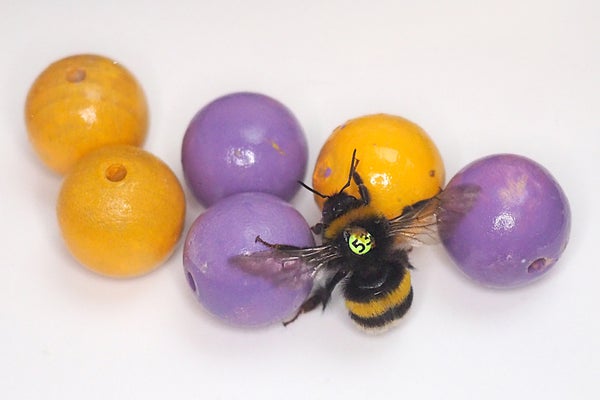
Ball-rolling bumblebees have become the first known insects to “play,” researchers say. The scientists recorded these tiny fliers manipulating wooden balls again and again in a series of new experiments.
When animals repeatedly engage in behavior that does not provide them with food, shelter or another immediate benefit, researchers consider the behavior play. Play with inanimate objects is widely observed in animals, although most examples come from mammals and birds, with no record of the behavior in insects until now.
Animal play is one piece of the puzzle when determining whether a group of animals is sentient—whether its members have inner feelings and experiences. Scientists consider mammals, birds, and increasingly cephalopods and fish to be sentient beings. “Eventually, this can tell us something more about whether [insects] are sentient,” says Samadi Galpayage, a graduate student in Lars Chittka’s lab at Queen Mary University of London and lead author of the new bumblebee study, which was published in Animal Behaviour.
On supporting science journalism
If you're enjoying this article, consider supporting our award-winning journalism by subscribing. By purchasing a subscription you are helping to ensure the future of impactful stories about the discoveries and ideas shaping our world today.
In 2017 Chittka and other scientists taught bumblebees to roll balls in exchange for a sugary prize. To determine whether ball rolling could be a form of “play” in the new investigation, Galpayage, Chittka and their colleagues needed to take away the reward. First, they set up a system that let bumblebees move in an unobstructed path to a sucrose solution in a feeding area. Along the path’s sides, the researchers placed small wooden balls of varying colors, some fastened to the floor and some loose. Bees could access the sucrose without interacting with the balls at all.
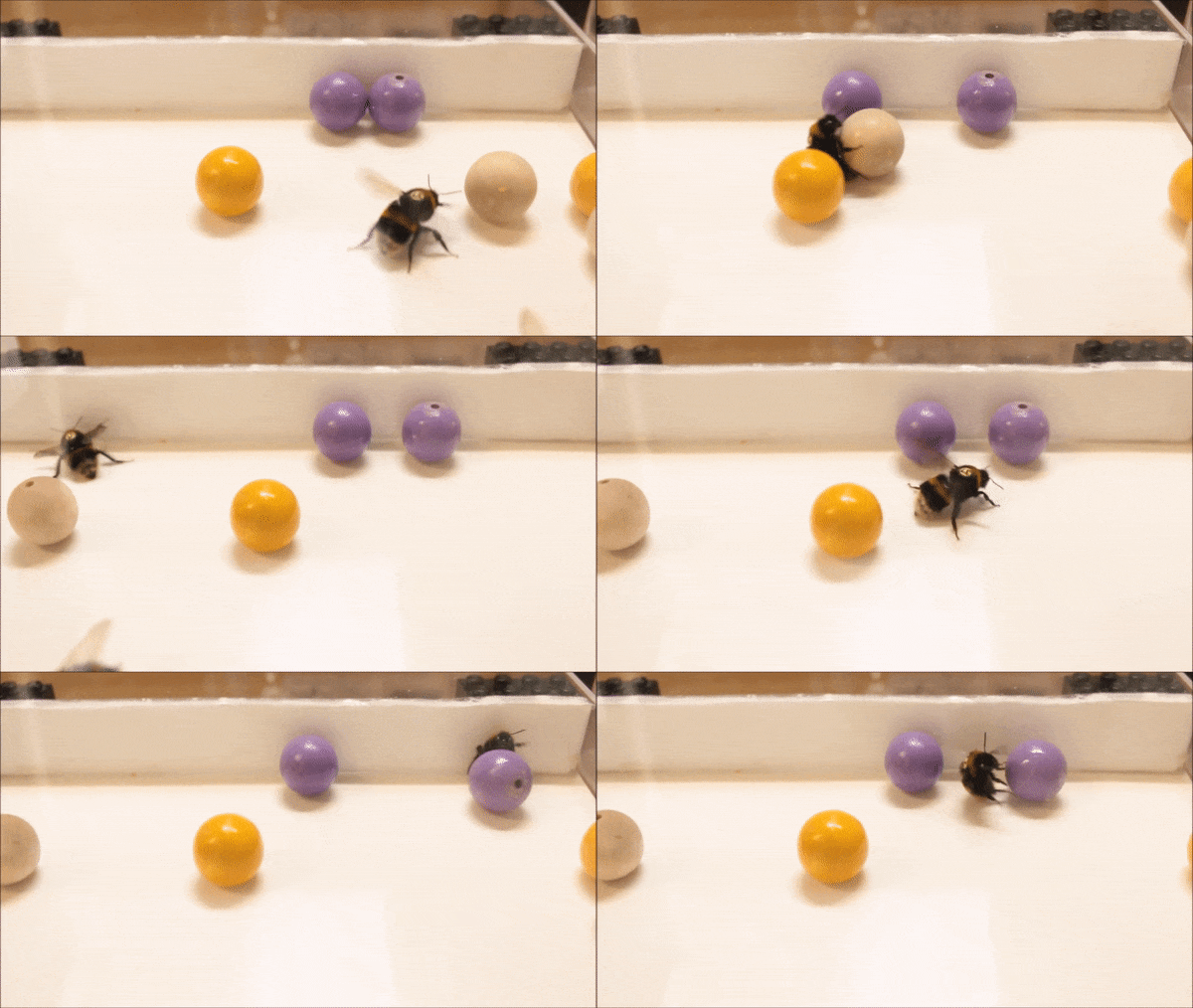
Bumble bee rolling a ball, video at half speed. Credit: “Do Bumble Bees Play?” by Hiruni Samadi Galpayage Dona et al., in Animal Behaviour. Published online October 19, 2022 (CC BY 4.0)
Over 54 hours, the team observed each of the experiment’s 45 bees contributing to 910 total ball-rolling actions. Some bees returned again and again, moving the balls in various patterns. The researchers found that feeding and ball-rolling activities happened at different times and frequencies, indicating that the bees had different motivations for the two actions. Younger bees and male bees were especially interested in rolling the balls.
In a later experiment, the scientists trained the bees to associate ball rolling with a certain chamber color. The bees then preferentially chose to enter that color chamber even when it was empty.
While these results illustrate play behavior in the bees, Galpayage says, the research does not show any motivations for it. Determining whether the insects are playing for pleasure, for instance, would require analyzing which neurotransmitters activate during ball rolling.
Olli Loukola, a behavioral ecologist at the University of Oulu in Finland, who led the ball-rolling study in 2017 and was not involved in the new work, also wonders about the behavior’s ultimate function. The interest in moving objects, he says, could be motivated by an “innate need to develop motor skills.”
Regardless of the play’s function, such studies can help researchers determine if a species is sentient, says Heather Browning, an animal welfare expert and philosopher at the University of Southampton in England.
“We don't have a good grasp yet on what the relationship is between sentience and different behaviors,” says Browning, who was also not involved in the study. Evidence for many different characteristics, such as play behavior, complex brain structure and learning ability “raise the probability of sentience.”
This study, Browning adds, “seems to be pointing in that direction.”
A version of this article with the title “Bee-Ball” was adapted for inclusion in the January 2023 issue of Scientific American.
