
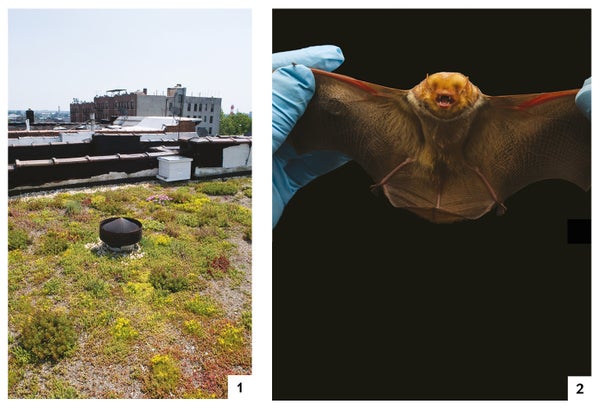
For years cities have encouraged residents to install green roofs—gardens that turn barren tar and asphalt roofs into verdant oases. The added foliage helps to keep buildings cool in the summertime and warm in the winter; it can also ease sewers by absorbing rainfall. But not just the hardscape benefits from these lush areas—so do some urban dwellers: bats.
“The general population of New York City, they see birds; they see insects. Occasionally they see fish,” says Kaitlyn Parkins, an ecologist at the Lower East Side Ecology Center. “But very rarely will a New Yorker tell you that they've seen a bat.”
On supporting science journalism
If you're enjoying this article, consider supporting our award-winning journalism by subscribing. By purchasing a subscription you are helping to ensure the future of impactful stories about the discoveries and ideas shaping our world today.
In fact, six native bat species flit amid the city's canyons of glass and steel—and they need places to roost and insects to eat. Research suggests that rooftop gardens are an excellent dining option because they support robust bug populations. “Lots of insects come in with the green roof material,” Parkins says. “But bugs are also pretty good at dispersing from nearby parks and other areas onto green roofs.” So in 2012 and 2013 Parkins (then at Fordham University) and her colleagues placed ultrasonic recorders on four barren rooftops and four others covered with vegetation to listen for the flying mammals' high-pitched chirps and squeaks. Although they detected bats over both roof types, they recorded twice as much activity on average over the green roofs. Software analysis of the squeaks indicated that the most common species was the tree-roosting eastern red bat.
The latest of the team's two studies was recently published in Urban Naturalist, and Parkins says that together, these studies show that green roofs are increasingly providing critical habitat for a broad array of species. She adds that green roofs cannot replace parks or other green spaces on the ground as ways to maintain urban wildlife. But they are a way of expanding habitats without taking up additional real estate, notes Joseph Duchamp, an associate professor of ecology at Indiana University of Pennsylvania, who was not involved with this project. Not to mention that bats lured by rooftop buffets may help keep pest numbers down at ground level—some can eat up to 1,000 mosquitoes an hour.
For now Parkins has a tip for New Yorkers: “Look up.”