
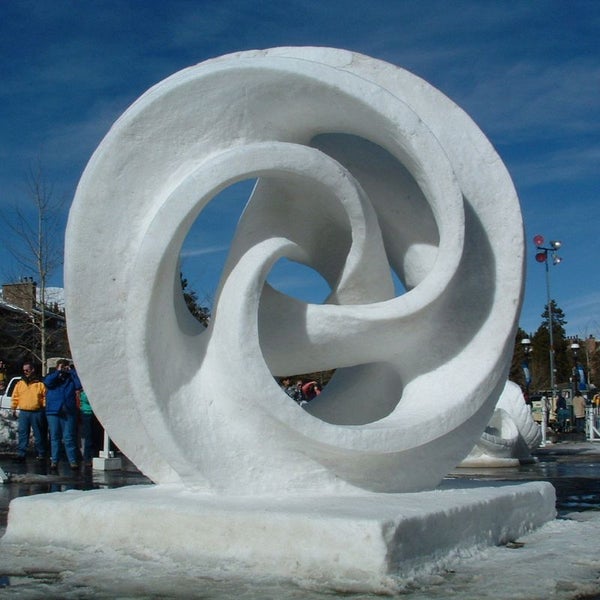
As much of the U.S. swelters in summer heat, a group of mathematicians and artists can look back fondly on chillier times.
Every winter, ski mecca Breckenridge, Colo., hosts the International Snow Sculpture Championships. Stan Wagon, a professor of mathematics and computer science at Macalester College, has assembled a team to compete in it almost every year since 1999.
Most of Team Minnesota's designs have employed negative curvature, or saddle shapes. That form seems to provide strength to the sculptures, although Wagon is not quite sure why. “We believe it resists the force of gravity; it resists falling and changing its shape,” he says. “If you just build a hollow ball, as soon as the sun hits it, it starts sagging from the top. But these saddle shapes resist.”
On supporting science journalism
If you're enjoying this article, consider supporting our award-winning journalism by subscribing. By purchasing a subscription you are helping to ensure the future of impactful stories about the discoveries and ideas shaping our world today.
In 2003 Wagon's team won second place for the sculpture Whirled White Web, designed by sculptor Brent Collins and computer scientist Carlo Séquin. The designers started with a mathematical object called a minimal surface. Minimal surfaces minimize area for a given boundary. For example, when you dip a wire frame into a soap solution, the film that forms is a minimal surface. More generally, minimal surfaces look at all points like a saddle in which both directions curve the same amount.
The specific kind of minimal surface Collins and Séquin used is called a Scherk surface. They modified it by giving it a “monkey saddle” shape, so called because it is optimized for monkey comfort: with room for a tail. Then they twisted this shape and closed it up to make a ring. To create the sculpture itself, they carved the carefully designed form out of a 20-ton brick of snow.
Creating a sculpture in less than a week from a huge mass of snow is no easy task, and contest rules prohibit power tools. But Wagon says the work is enjoyable, and seeing a design come together so quickly is a great feeling. “The real joy of the event is that one can do in four days what would take four or eight years in stone.”
Snow is also less permanent than stone, however. The final day of the competition in 2003 was unusually warm, and Whirled White Web collapsed less than an hour after being judged. Only the good die young.
—Evelyn Lamb