
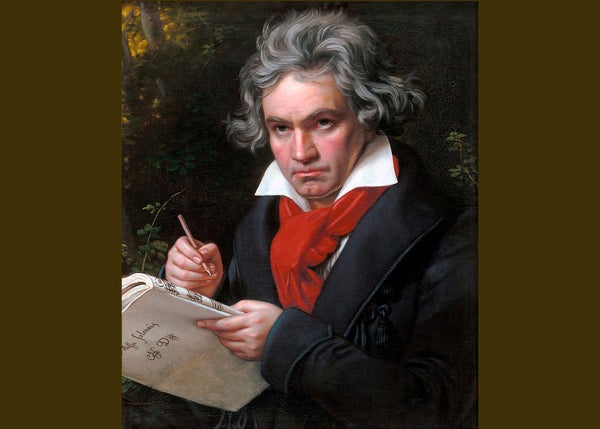
In the autumn of 1802, some 25 years before his death, Ludwig van Beethoven wrote a letter to his brothers. The famous composer, distraught about his encroaching loss of hearing, implored them to seek out his physician after his death and “beg him in my name to describe my malady.”
More than two centuries on, researchers have come the closest yet to honoring that wish. Tristan Begg, an ancient-genome researcher at the University of Cambridge, UK, and his colleagues extracted genetic material from preserved locks of hair that are purported to be Beethoven’s. Previous attempts to extract genetic material from the composer’s hair or skull fragments had failed. But advances made over the past two decades in methods for sequencing DNA from centuries-old, degraded samples enabled the latest study.
Unfortunately, the cause of Beethoven’s hearing loss remains a mystery, but the analysis suggests that the composer probably died from liver disease brought on by a combination of factors. The study is published this week in Current Biology.
On supporting science journalism
If you're enjoying this article, consider supporting our award-winning journalism by subscribing. By purchasing a subscription you are helping to ensure the future of impactful stories about the discoveries and ideas shaping our world today.
Begg tested eight locks that are claimed to be from Beethoven. Five matched each other and were assumed to be authentic samples of the composer’s hair. The team was then able to extract genetic material from one sample and produced a sequence covering about two-thirds of the genome, which they analyzed for known disease-causing genetic sequences.
The work is “a great technological achievement,” says Walther Parson, a forensic molecular biologist at the Medical University of Innsbruck in Austria who has worked on other historic cases. These include the identification of two children of Nicholas II, the last Tsar of the Russian Empire, from remains discovered in 2007.
Obtaining useful genetic material from such old hair is not easy. “The procurement of the sample material alone is admirable,” says Christian Reiter, a forensic medical specialist at the Medical University of Vienna who authenticated a portion of Beethoven’s skull in 2022.
Death from liver disease
The latest study suggests that Beethoven probably died from liver disease brought on by a combination of viral hepatitis, alcohol consumption and genetic factors. “There was a perfect storm,” says Begg.
The DNA extracted showed that Beethoven had two copies of a particular variant of the gene PNPLA3 that has been linked to liver cirrhosis. He also had single copies of two variants of the HFE gene that cause hereditary haemochromatosis, a condition that damages the liver. “Those are really significant,” says Begg, given that historical reports suggest Beethoven was a heavy drinker, especially in the year before his death, which would have further increased his risk of liver damage.
DNA extracted from hair cut from the composer’s head after his death also contained fragments of the hepatitis B virus, which can cause liver damage. “We don’t know when he got it or how he got it,” says Begg, who suspects that Beethoven had a chronic, dormant infection that was reactivated in the months before he died.
The findings align with historical accounts of Beethoven’s demise. In December 1826, the composer’s health deteriorated rapidly. He developed jaundice and his limbs swelled—both signs of liver failure. He took to his bed and remained there until his death in March 1827.
Ian Gilmore, a liver specialist at the University of Liverpool, UK, says that the hair analysis points to various potential causes of liver cirrhosis, and “the truth probably lies in the interaction between several of these.”
Genes silent on cause of deafness
The cause of Beethoven’s hearing loss remains a mystery. Begg and his colleagues scanned the composer’s genome for several conditions linked to hearing loss, including Paget’s disease and lupus. Beethoven had a number of genetic markers indicating a heightened risk of developing lupus, but because the condition is rare and doesn’t always lead to hearing loss, Begg doesn’t think it’s a strong contender as the cause of his deafness.
“Medical genetics struggles with the same problems in patients that are alive today,” says Parson. “The DNA sequence doesn’t provide all the information that is required to understand the causes for a disease.”
Medicals historians have speculated that otosclerosis—a condition in which a tiny ear bone called the stapes fuses with other parts of the ear—might have been responsible for Beethoven’s hearing loss. The genetic causes of otosclerosis are yet to be identified, so this remains possible, but the theory cannot be confirmed by this study. Begg says that if genetic links are identified in the future, the team could recheck Beethoven’s genome.
Parson says that now that Beethoven’s genetic information is publicly available, it will probably spur amateur sleuths to investigate further and explore how they might be related to the renowned composer. “Like all good stories, it leaves us with as many questions as answers,” he says.