
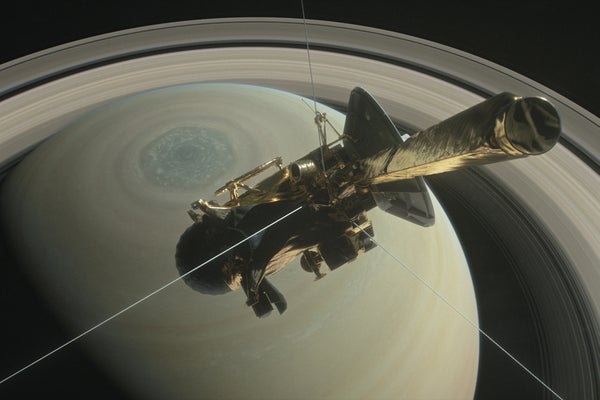
Saturn’s massive rings and its icy moon Enceladus have long been known to interact with the gas giant’s magnetic field via energy-rich waves of plasma, or ionized gas. Now, for the first time, researchers have detected the gas giant sending similar signals back toward its rings and moon, closing the magnetic loop. The new observations were made in the final days of NASA’s Cassini mission, as the spacecraft danced inside the planet’s rings en route to its fiery rendezvous with the planet.
Electric currents present in the rings and the Saturnian moon generate the plasma waves. Although the rings and moon use slightly different methods to produce these currents, the results are the same: an electrically charged connection to Saturn, courtesy of the planet’s magnetic field. Enceladus acts like a little generator and applies electric currents to Saturn, and the cloud-enshrouded planet is providing its own electric current back to essentially make a circuit," says Ali Sulaiman, a member of Cassini’s Radio and Plasma Wave Science instrument team, and the lead author on a pair of studies published in June in Geophysical Research Letters.
Scientists call the plasma waves an “auroral hiss,” because “you can take those frequencies and transform them into an audio signal, and when you play it back, it sounds like a hiss.” The process is similar to how a radio translates electromagnetic waves into music.
On supporting science journalism
If you're enjoying this article, consider supporting our award-winning journalism by subscribing. By purchasing a subscription you are helping to ensure the future of impactful stories about the discoveries and ideas shaping our world today.
That’s just what NASA did, compressing the 16-minute recording to 28.5 seconds, which you can listen to here:
But the term auroral hiss is something of a misnomer. It was first used to describe a process that was observed near Earth’s auroras, but it turns out the two phenomena are not really related. Plasma waves also do not make a sound in the vacuum of space. Even Saturn’s upper atmosphere is too thin for the waves to produce a noise.
On Enceladus, geysers gushing from its southern pole generate charge. As the water flows out into space, the neutral particles are ionized by the sun. These particles flow along the moon’s magnetic field lines to Saturn. As they crash into the atmosphere of the ringed giant, they can light up like the northern lights, creating what’s called an auroral footprint. At the same time, Saturn sends charged particles from its own atmosphere back toward the moon.
A slightly different process creates the current in the rings. Neutral particles in the rings rotate under the influence of gravity whereas charged particles move in reaction to the planet’s magnetic field. The difference in speed between the two types of particles creates a current that follows the magnetic field lines to Saturn. As with Enceladus, the planet completes the circuit by sending its own charged particles back.
Whereas the rings bombard Saturn on all sides with plasma waves, Enceladus only has a narrow magnetic connection to the planet. Both sets of plasma waves flow continuously to Saturn and back. The spacecraft clipped the edge of this thin beam of plasma waves on the final days of its mission.
The new findings of Saturn’s electromagnetic connection do not come as a total shock. “It’s the first definite observation, but it’s not a surprise,” says Japheth Yates, a European Space Agency researcher who studies planetary magnetospheres but was not part of the studies.
Over its 13 years orbiting Saturn, Cassini observed the band of plasma waves produced by the moon and the rings. It also observed the auroral footprint of several of the moons. Only in the final days of its grand finale, immediately before it took a deliberate death dive into the planet, was the spacecraft able to detect Saturn’s particles surging outward. In its last several orbits Cassini danced in and out of the space between the planet and its rings, allowing scientists to catch their first glimpse of Saturn’s particle stream. “For the first time, because the grand finale was very up close in its orbit to Saturn, we’re able to see the signal coming from Saturn,” Sulaiman says.
The new finding may not be a surprise, but it does reveal a few things about Saturn’s environment. “It underpins that the Saturn system is arguably the most diverse and dynamic system in the solar system,” Sulaiman says. “It’s having all of these interactions with its environment.”