

The beluga whale’s “melon”—a technical term—is a mass of fat tissue on its forehead that helps to project sounds for echolocation. And new research suggests that despite whales’ seemingly stone-faced countenances, they shake, wiggle, thrust and bump these bulbous blobs to convey something a little like facial expressions.
For a study in Animal Cognition, scientists tracked four beluga whales at Connecticut’s Mystic Aquarium for more than 200 hours and observed roughly 2,500 instances of these mammals morphing their melons. To investigate if the movements might be intentional communication, the researchers carefully observed whether they occurred in a social context and within view of other whales. The team documented five distinct melon morphs used repeatedly in various situations.
A “melon shake” appears to be used primarily by males toward females during courtship. A “melon push” seems to be a display of aggression.
On supporting science journalism
If you're enjoying this article, consider supporting our award-winning journalism by subscribing. By purchasing a subscription you are helping to ensure the future of impactful stories about the discoveries and ideas shaping our world today.
“We have known, intuitively, that they do this,” says Justin Richard, the study’s lead author and an animal scientist at the University of Rhode Island. “But this is the first time we have documented it rigorously.”
Richard says scientists should be cautious about ascribing meaning to the shapes at this stage—but he does note some patterns. A jiggly “melon shake” appears to be used primarily by males and to be directed toward females during courtship. An elongating “melon push” seems to occur among both males and females and may be a display of aggression, as it makes the whales look larger. Researchers are still investigating what might prompt the other three distinctive moves.
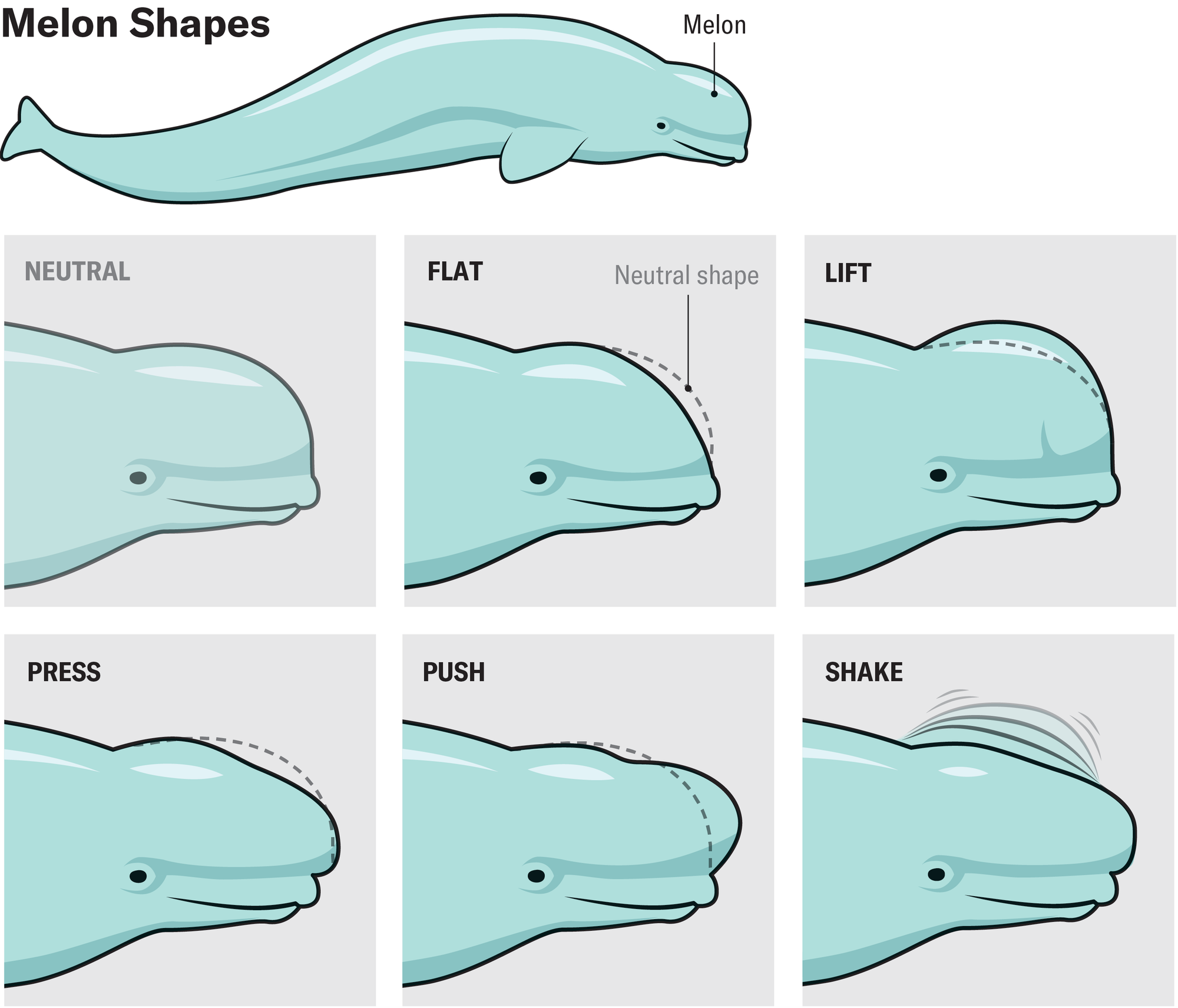
Amanda Montañez; Source: “Belugas (Delphinapterus leucas) Create Facial Displays during Social Interactions by Changing the Shape of Their Melons,” by Justin T. Richard et al., in Animal Cognition, Vol. 27, No. 7; March 2, 2024 (reference)
“I certainly think they are able to use their melons in a communicative fashion,” says comparative psychologist Heather Hill, who researches marine mammal behavior at St. Mary’s University in Texas. “But whether the beluga movements are specific to all belugas or just that population, we don’t know that information yet.” She adds, however, that the study’s melon shapes are the same as the ones she sees in captive belugas in San Antonio.
The study “is a good first step at looking at facial displays in a highly social species that has been neglected in the communication field,” adds Simon W. Townsend, an animal-communication specialist at the University of Zurich. Next, he’d like to see whether other individuals respond to a shape-shifting melon.