
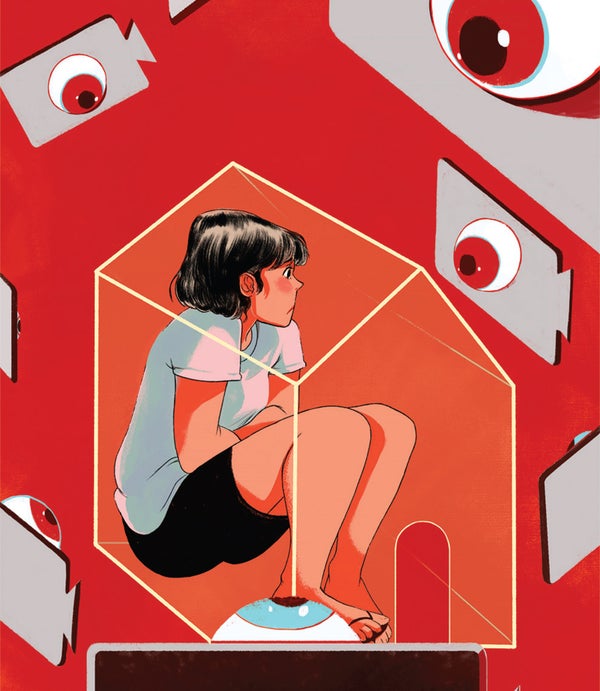
I'll never forget being creeped out by “Private Eye,” a 1949 short story by Henry Kuttner and C. L. Moore. In it, a futuristic technology lets “forensic sociologists” replay anything that's ever happened, going back 50 years, by analyzing walls and surfaces. The protagonist plans a murder entirely in his head, knowing that everything he says and does is being recorded. “It is nerve-racking to know you're living under the scrutiny of an extratemporal Eye,” he thinks to himself.
No kidding. He ultimately engages in 18 months of serving and flattering the man he intends to kill, all to throw off the future investigation.
I remembered that story when I reviewed a home security camera called the Nest Cam IQ. Like most Wi-Fi cameras, it lets you peek in on your home from anywhere, using your phone—and even rewind into the past. For a fee, this camera stores up to 30 days' worth of continuously recorded video.
On supporting science journalism
If you're enjoying this article, consider supporting our award-winning journalism by subscribing. By purchasing a subscription you are helping to ensure the future of impactful stories about the discoveries and ideas shaping our world today.
I set the camera up downstairs, with a full 130-degree view of our kitchen and eating area. It never did capture a burglary. It did, however, reveal all kinds of things I was not expecting.
They started small. Rewinding the footage one morning, I discovered something I'd never known about our cat, Wilbur. My wife and I have always thought he sleeps all night at the foot of our bed. In fact, in the middle of every night he slips downstairs and makes a few nonchalant circuits through the kitchen—some ancient, instinctual mouse patrol he's kept secret from us for 15 years.
Another time I caught something else surprising on video: me. I'd snuck downstairs for a midnight snack in my T-shirt and underwear, forgetting about the camera. For the first time I can remember, I was watching video of myself when I didn't know I was on camera. Think about it: When do you ever get to see extended footage of yourself, shot from the side, without your knowledge? Unless you hold up a 7-Eleven and watch the security camera footage at your trial, probably never.
It wigged me out a little. I'd never realized that my posture disintegrates when I'm tired.
If the difference between conscious and unconscious video recording hadn't quite sunk in yet, my wife hammered it home. At the moment, she and I live on opposite coasts some of the time. When we're apart, we use video calls, text messages and nightly chats to keep in constant contact.
So I thought it'd be supercool to introduce a little telepresence into our relationship. I proposed buying one of these Nest-type cameras and setting it up in her San Francisco apartment so I could feel like I was always there. We could even converse at will because the camera has built-in microphone and speakers.
She did not find the idea supercool. She found it creepy.
She was right, of course.
Over the years I've done my share of scoffing at people who make a fuss over privacy. Yeah, yeah, the big tech companies are collecting data about us. What's the big deal? If you have nothing to hide, why would you care? You're expressing an irrational fear.
But this Nest Cam experience has taught me something: the desire not to be observed unknowingly is irrational. It's emotional—primal, in fact. It doesn't matter that we've done nothing wrong. It doesn't matter if we're married to the observer. It doesn't even matter if we ordinarily enjoy being on camera, as I do. (I've been a show-off since elementary school.) We simply want to know when the camera's rolling.
We don't mind when we're doing the watching, of course. We love it when hidden cameras catch wrongdoing, whether it's a corrupt politician on 60 Minutes, burglars in our homes or police brutality caught on phone video. By behaving badly, those people waive their right to video privacy—right?
We're not in the “Private Eye” world quite yet. But with every passing year we're unwittingly being recorded by more cameras. There may soon come a time when we have to start considering how we behave in “private”—whether we may have something to hide or not.