
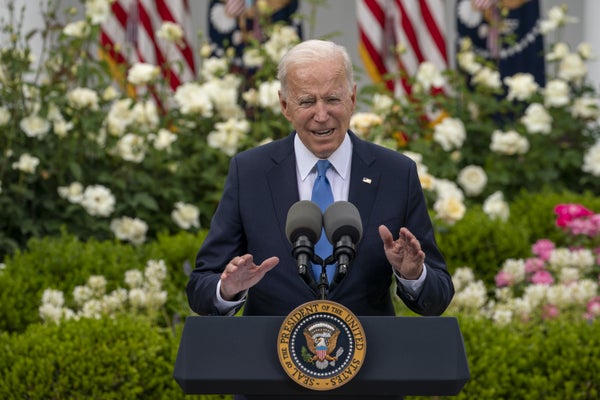
CLIMATEWIRE | President Joe Biden will issue an executive order Friday afternoon to expand federal protections for communities historically overburdened by pollution.
The order takes aim at the cumulative impacts on Black, brown and low-income residents from pollution and past racist zoning laws that often concentrated people in neighborhoods with industrial facilities. Biden will announce the order during a Rose Garden speech on the eve of Earth Day, flanked by environmental justice luminaries and community leaders.
“Communities with environmental justice concerns have long experienced exclusion and other significant barriers to having a voice in federal decision-making,” says a White House fact sheet on the order. “The Executive Order recognizes this reality and that racism is a fundamental driver of environmental injustice.”
On supporting science journalism
If you're enjoying this article, consider supporting our award-winning journalism by subscribing. By purchasing a subscription you are helping to ensure the future of impactful stories about the discoveries and ideas shaping our world today.
The order directs agencies to expand “meaningful public participation and just treatment” in federal decisionmaking and establishes a new Office of Environmental Justice within the White House to coordinate work across the federal government. It instructs agencies to fill gaps in environmental justice research and data and directs them to develop, implement and update environmental justice strategic plans for programs under their purview.
The Biden administration has made environmental justice a signature issue by creating dedicated positions and offices across a host of agencies and promising that disadvantaged communities will see 40 percent of the benefits from climate and infrastructure spending.
Biden will announce Friday that three additional agencies — the Department of Commerce, the National Science Foundation and NASA — will be included under the Justice40 pledge.
The White House said Biden would use his Rose Garden speech to draw a “stark contrast to the dangerous vision Speaker McCarthy and his extreme caucus have for our planet, our economy, and public health,” referring to efforts by House Speaker Kevin McCarthy of California to roll back portions of the climate law known as the Inflation Reduction Act.
The White House also blasted the environmental and energy policies of “extreme MAGA Republicans," who it mentioned five times in the statement announcing the executive order.
Those comments come as Biden prepares to announce his bid for reelection.
The administration also will unveil the long-awaited Environmental Justice Scorecard on Friday — an assessment created in an early Biden executive order that grades agency performance on environmental justice issues.
EPA in addition will release a strategy to combat disparate impacts from plastic pollution in communities and federal agencies will be ordered to notify nearby communities when there is a toxic leak from a government facility.
To mark Earth Day, Vice President Kamala Harris will travel Friday to Florida for announcements on improving coastal resilience in the face of climate change.
Reprinted from E&E News with permission from POLITICO, LLC. Copyright 2023. E&E News provides essential news for energy and environment professionals.