
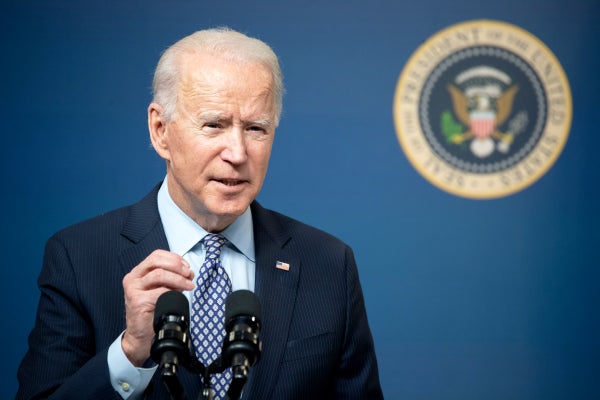
Will Joe Biden be a successful science president? It’s not certain, but early signs are pointing that way.
More significantly, though, will Congress and the public accept his science-based policies? That’s a dicier question, and the answer in part depends upon what he does to build trust in science.
When Biden convenes his Cabinet in the coming weeks, science will have a seat at the table. That’s extremely important, as history shows. Thirty-two years ago, George H.W. Bush accorded his science adviser, D. Allan Bromley, the title of assistant to the president and began including him in Cabinet meetings. The result: far greater reliance on science for policymaking.
On supporting science journalism
If you're enjoying this article, consider supporting our award-winning journalism by subscribing. By purchasing a subscription you are helping to ensure the future of impactful stories about the discoveries and ideas shaping our world today.
Bromley went one step further, securing a small office in the West Wing, which he later noted had made the difference between simply formulating science and technology policy and actually seeing it executed. Eric Lander, a prominent MIT geneticist, whom Biden has tapped as his science adviser and director of the Office of Science and Technology Policy (OSTP), would be wise to make a similar pitch for space.
Lander will be joined by a number of other well-credentialed scientists in the new administration, giving the president access to some of the best minds in the country. But having experts on board is only the first step.
A president has to use their expertise effectively. Historically, some have; others haven’t. George H.W. Bush and Barack Obama are among the prominent “haves.” George W. Bush, who denied his science advisor direct access to the Oval Office, and Donald J. Trump, who found science an infuriating impediment to his fact-free, authoritarian policymaking, are among the leading “haven’ts.”
Joe Biden’s first directive to Lander suggests where he might fit. Just a few days after his inauguration, the president asked Lander to have OSTP update America’s 75-year-old science and technology policy paradigm, which still carries the imprimatur of President Franklin D. Roosevelt’s de facto science adviser, Vannevar Bush, an eminent MIT engineer. But, again, Biden’s request is just a first step.
Developing a plan and having it implemented is the tough part, as Bush learned when his post–World War II blueprint “Science the Endless Frontier,” ran into opposition from a populist Democratic senator from West Virginia. Harley Kilgore, a graduate of West Virginia University, didn’t trust scientific elites, especially those with pedigrees from institutions such as MIT. Bush’s plan languished for five years, as the Senate jockeyed back and forth between Democratic and Republican control.
The strain of anti-elitism is far stronger today, and public trust in institutions is far weaker than it was when World War II ended in 1945. Once again, a Democratic senator from West Virginia with a populist bent and a degree from the University of West Virginia holds the keys to the future, as Joe Manchin III demonstrated recently when he brought an evenly divided Senate to a standstill for 12 hours during debate over the $1.9 trillion COVID-19 stimulus bill.
In the end, though, to be successful a new blueprint for science must embody a plan for building broad public trust, something Vannevar Bush regrettably took for granted. That trust can only come about when the public, in all its diversity, recognizes that its concerns are honestly and fully heard. In other words, members of the public must be participants in the process, not just top-down receptors. But engaging them successfully requires understanding how they view science.
Fortunately, we have a pretty good idea. Surveys conducted by the nonprofit organization ScienceCounts reveal that although science gets pretty high marks, most people view it through a distinctly transactional lens. If it delivers discernable personal benefits and, more importantly, if it does not conflict with strongly held beliefs, then the average American will give it a high five. If it fails in either respect, it will get a thumbs-down.
To avoid the pitfalls, a 21st-century science blueprint should bring science into the public square, breaking new ground in the process in three crucial ways. First, it should encourage scientists and policy makers, for whom preaching is a hallmark, to listen and take seriously what their audiences have to say. A “trust me” attitude never builds trust the way a two-way conversation does, as every successful politician knows.
Second, it should broaden discussions from the national stage, where public institutional trust remains extremely low, to dialogues in local communities, where trust is much higher. Just as people hold nurses and doctors in greater esteem than federal bureaucrats, people are likely to value an opinion of a civic-minded scientist who lives next door more than a wonky analysis by a Washington muckety-muck, however well-credentialed the latter might be.
Finally, it should bring into the fold groups who are traditionally disenfranchised in science and technology policymaking, among them African Americans, Hispanic Americans, Native Americans, new immigrants and many young people.
With Americans’ trust in scientists surging in 2020, according to a recent ScienceCounts survey, the time for promoting dialogue in the local public square is now. The outcome could be profound: helping to overcome vaccination hesitancy, especially in some Black and Hispanic communities; breaking down the partisan divide on climate change; confronting inequality; and highlighting the individual benefits of federal investments in science.