Billionaire Space Tourism Has Become Insufferable

From brave exploration to just another playground for the 0.0000001 percent

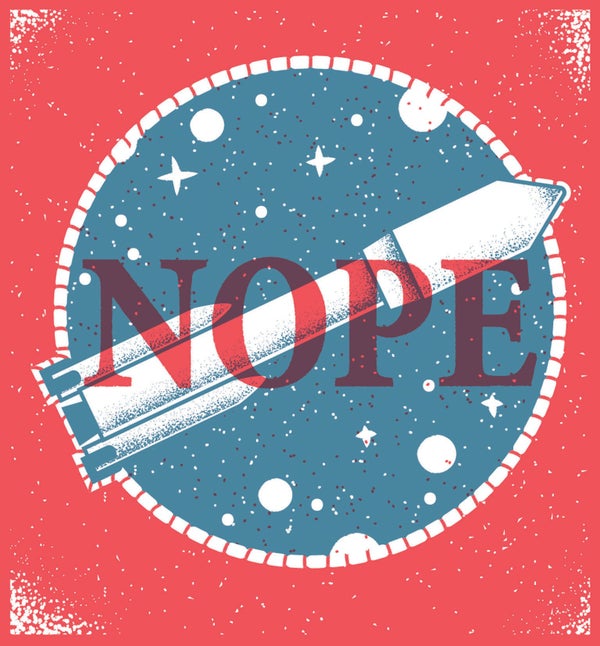
The text 'NOPE' across a space rocket.

James Olstein

Join Our Community of Science Lovers!


On supporting science journalism

If you're enjoying this article, consider supporting our award-winning journalism by subscribing. By purchasing a subscription you are helping to ensure the future of impactful stories about the discoveries and ideas shaping our world today.


Last summer, at a time when the pandemic had strained many people’s finances, inflation was rising and unemployment was still high, the sight of the richest man in the world joyriding in space hit a nerve. On July 20 Amazon founder Jeff Bezos rode to the edge of space onboard a rocket built by his company Blue Origin. A few weeks earlier ProPublica had revealed that he did not pay any income taxes for two years, and in other years he paid a tax rate of just 0.98 percent. To many watching, it rang hollow when Bezos thanked Amazon’s workers, whose low-paid labor had enriched him enough to start his own rocket company, even though Amazon had quashed workers’ efforts to unionize several months before. The fact that another billionaire, Richard Branson, had also launched himself onboard his own company’s rocket just a week earlier did not help.

COVID changed many people’s willingness to shrug off the excesses of the rich. The pandemic drew an impossible-to-ignore distinction between those who can literally escape our world and the rest of us stuck on the ground confronting the ills of Earth: racism, climate change, global diseases. Even several members of Congress expressed their disapproval of Bezos. “Space travel isn’t a tax-free holiday for the wealthy,” said Representative Earl Blumenauer of Oregon. Bezos and Branson putting the spotlight on themselves as passengers served to downplay the work that hundreds of scientists and engineers at Blue Origin and Virgin Galactic had put into designing, building and testing their spacecraft. It also masked the reality that advances in private spaceflight really could eventually pay off in greater access to space for all and more opportunities for scientific research that could benefit everyone. All their flights did was give the impression that space—historically seen as a brave pursuit for the good of all humankind—has just become another playground for the 0.0000001 percent.

Clara Moskowitz is chief of reporters at Scientific American, where she covers astronomy, space, physics and mathematics. She has been at Scientific American for more than a decade; previously she worked at Space.com. Moskowitz has reported live from rocket launches, space shuttle liftoffs and landings, suborbital spaceflight training, mountaintop observatories, and more. She has a bachelor’s degree in astronomy and physics from Wesleyan University and a graduate degree in science communication from the University of California, Santa Cruz.

More by Clara Moskowitz
Scientific American Magazine Vol 326 Issue 3This article was published with the title “Billionaire Space Tourists Became Insufferable” in Scientific American Magazine Vol. 326 No. 3 (), p. 55
doi:10.1038/scientificamerican0322-55

It’s Time to Stand Up for Science

If you enjoyed this article, I’d like to ask for your support. Scientific American has served as an advocate for science and industry for 180 years, and right now may be the most critical moment in that two-century history.

I’ve been a Scientific American subscriber since I was 12 years old, and it helped shape the way I look at the world. SciAm always educates and delights me, and inspires a sense of awe for our vast, beautiful universe. I hope it does that for you, too.

If you subscribe to Scientific American, you help ensure that our coverage is centered on meaningful research and discovery; that we have the resources to report on the decisions that threaten labs across the U.S.; and that we support both budding and working scientists at a time when the value of science itself too often goes unrecognized.

In return, you get essential news, captivating podcasts, brilliant infographics, can't-miss newsletters, must-watch videos, challenging games, and the science world's best writing and reporting. You can even gift someone a subscription.

There has never been a more important time for us to stand up and show why science matters. I hope you’ll support us in that mission.

Thank you,

David M. Ewalt, Editor in Chief, Scientific American

Subscribe