
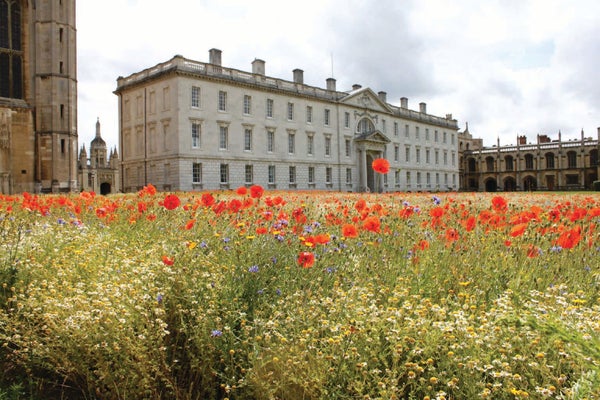
The well-manicured lawn behind King's College Chapel at the University of Cambridge predated the American Revolution. Then, in 2019, an ecologically minded head gardener secured permission to tear up a portion of the grass and plant a meadow in its place. Before long it bloomed with poppies, buttercups and Queen Anne's lace.
Lawns, which became popular in the 1700s as displays of wealth, come at an environmental cost. They require far more water than similar-size meadows, especially in arid regions. Lawn grass is often overloaded with fertilizers and pesticides and is regularly clipped with gas-guzzling mowers. Meadows, in contrast, sequester more carbon than lawns and foster far more biodiversity.
Yet at half the size of a soccer field, how much wildlife would the new Cambridge meadow really support? King's College botanist Cicely A. M. Marshall surveyed the site before and after its makeover. She and her colleagues found that, compared with their numbers in the remaining lawn, plants, bats, spiders, true bugs and other invertebrates had flourished in the meadow. And without the need for much mowing or any fertilizer, the meadow's upkeep led to 99 percent less greenhouse gas emissions per hectare than the lawn.
On supporting science journalism
If you're enjoying this article, consider supporting our award-winning journalism by subscribing. By purchasing a subscription you are helping to ensure the future of impactful stories about the discoveries and ideas shaping our world today.
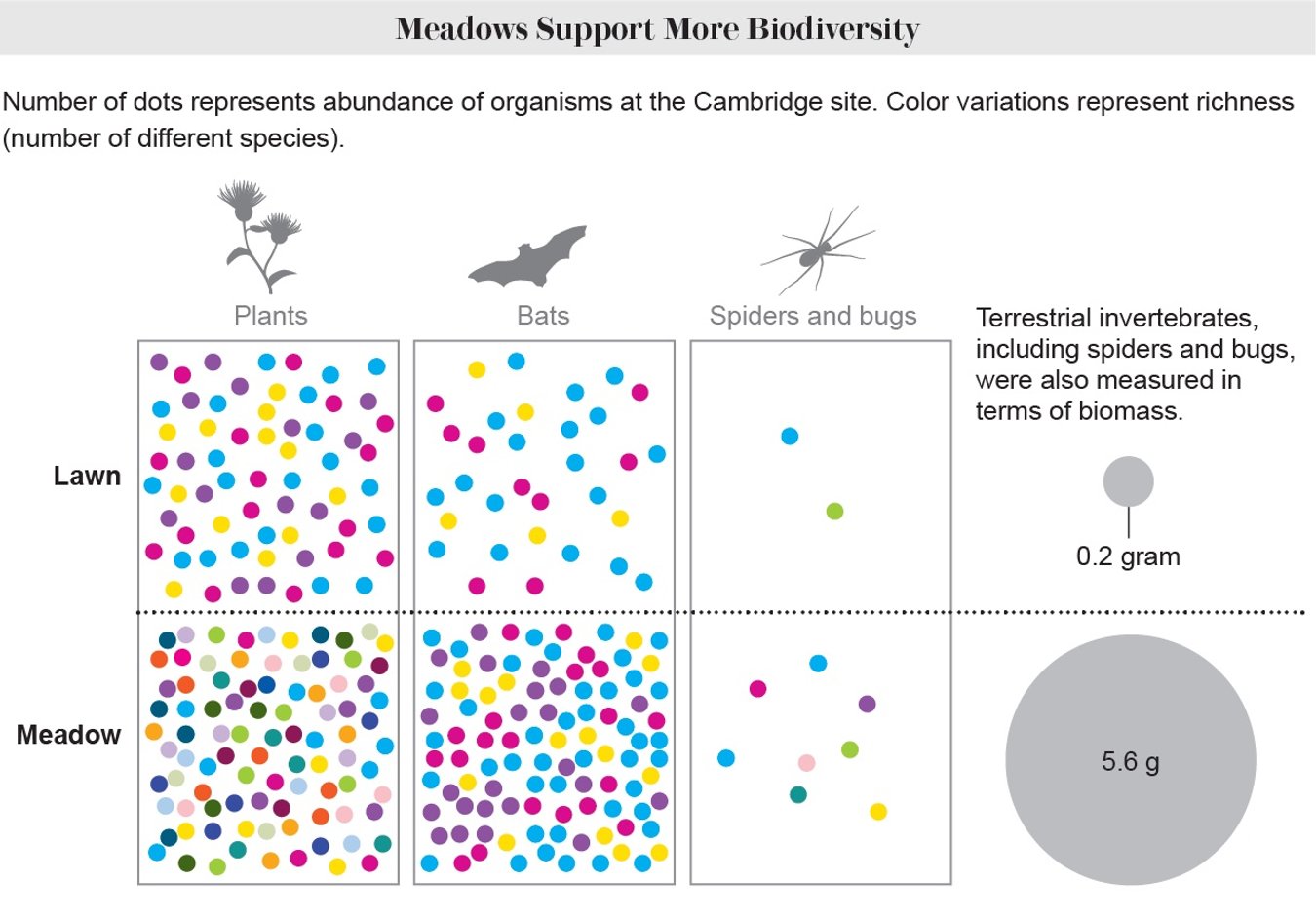
Credit: Amanda Montañez; Source: “Urban Wildflower Meadow Planting for Biodiversity, Climate and Society: An Evaluation at King’s College, Cambridge,” by Cicely A. M. Marshall et al., in Ecological Solutions and Evidence, Vol. 4; May 2023
Perhaps because it's hemmed in by buildings and a river, no mammals but bats were observed at the site, and it is too small for grassland birds.* In addition, roundworms equally inhabited the meadow and the lawn. Even so, Marshall says she was “quite encouraged” by the results, which were recently published in Ecological Solutions and Evidence.
“Lawns represent an incredible loss of habitat,” says Sam Quinn, a conservation biologist at the State University of New York College of Environmental Science and Forestry, who was not involved in the new study but expressed admiration for its experimental setup. Fortunately, “the restoration part is super easy,” he says; once the new plants get established, “beneficial organisms” move right in.
*Editor’s Note (10/17/23): This sentence was edited after posting to correct the description of which mammals were not observed at the study site.