
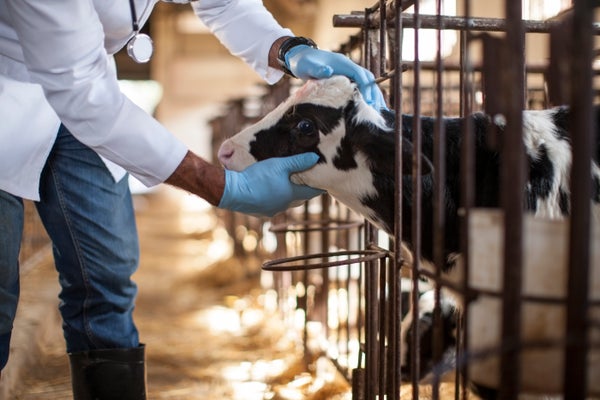
As bird flu sweeps across US poultry and cattle farms, researchers are racing to find ways to contain the outbreaks before they ignite a human pandemic. Now, a team of scientists has developed a fresh approach: the first mRNA bird-flu vaccine for cattle.
Early findings, posted this month on the preprint server bioRxiv, reveal that the experimental vaccine triggers a strong immune response to the virus, and protects against infection in calves. The results have not yet been peer-reviewed.
This development could mark a crucial step towards creating flu vaccines for livestock and reducing the risk of animal-to-human transmission of a virus that poses a “real pandemic threat”, says Scott Hensley, a virologist at the University of Pennsylvania in Philadelphia, and a co-author of the work.
On supporting science journalism
If you're enjoying this article, consider supporting our award-winning journalism by subscribing. By purchasing a subscription you are helping to ensure the future of impactful stories about the discoveries and ideas shaping our world today.
Fears of a bird-flu pandemic have been rising since the first confirmed outbreak of the H5N1 avian influenza virus in dairy cattle was reported in March 2024. Since then, the virus has affected more than 1,000 dairy herds across 17 US states. Health officials have linked 64 human infections and one death to the outbreak.
A fresh approach
To create a cattle vaccine, Hensley and his team built on more than a decade of work on seasonal bird-flu mRNA vaccines. The researchers took one such vaccine candidate and swapped out its viral haemagglutinin gene — which encodes a protein known to elicit an immune response — with the corresponding gene from the new H5N1 virus found on dairy farms. “It’s so easy to switch,” says Hensley. “That’s really the value of using mRNA-based vaccines.”
Last year, Hensley’s team showed that their vaccine protects against avian flu in ferrets, a commonly used laboratory model for testing flu vaccines. For the latest work, they inoculated 10 calves and, 49 days later, fed them milk from H5N1-infected cows — a suspected route of transmission among cattle.
After that exposure, the vaccinated calves had significantly lower levels of viral RNA than the unvaccinated calves did, indicating that the vaccine helped to curb infection.
The study tested only vaccine responses in calves; much of the avian-flu transmission on dairy farms occurs among lactating adult cattle, says virologist Richard Webby, director of the World Health Organization Collaborating Centre for Studies on the Ecology of Influenza in Animals and Birds in Memphis, Tennessee. Hensley’s team is already working on extra trials in lactating cows.
Even without that data, the current results are a strong first step towards developing a vaccine: “It’s good news,“ Webby says.
Uncertain future
Other livestock vaccines could be on the way. The US Department of Agriculture has approved at least seven candidates for field trials this year. In mid-February, the agency also conditionally approved a bird flu vaccine for chickens.
But political headwinds against mRNA vaccines could threaten Hensley’s effort. Republican lawmakers in South Carolina, Texas and Montana have introduced bills to ban mRNA vaccines in livestock, arguing that they pose risks to human health. And some scientists worry that vaccine scepticism in US President Donald Trump’s administration will lead to cuts in funding for mRNA-vaccine development.
“I’m optimistic that they will continue to support the development of these vaccines,” Hensley says. “It would be a crime right now to stop it.”
Other scientists question whether vaccines for cattle will be economically viable for farmers. That will depend on how many doses are needed and its price, says microbiologist Shollie Falkenberg at Auburn University in Alabama. “The livestock industry is in the business of making money,” she says. “At the end of the day, people want to see the economics behind it.”
Still, vaccinating cattle might soon become necessary to prevent further infections, potential deaths and mounting economic losses, says Webby.
“I don’t think that cattle vaccines on their own are sort of a silver bullet,” he says. “But we have to do something different because what we're doing now is clearly not working.”
This article is reproduced with permission and was first published on May 21, 2025.