
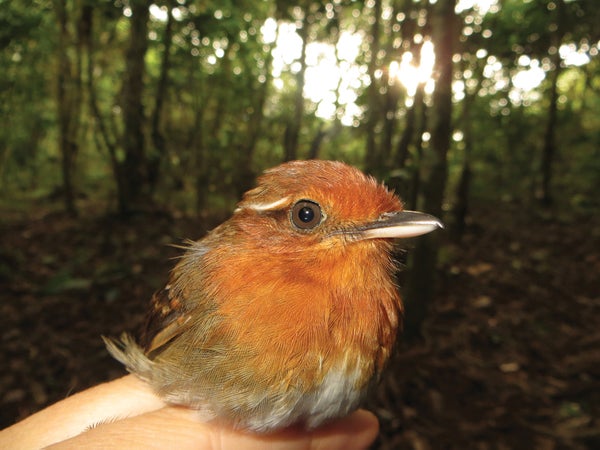
For most birds, eyes are essential to life on the fly. They inform split-second aerobatic maneuvers amid dense branches and pinpoint distant predators or prey. Yet when studying how birds might adapt to our quickly changing world, ornithologists have largely overlooked eye size in favor of traits such as wing length and beak shape. Now, though, a lost “treasure trove” of avian eyeball measurements offers a new view.
In 1982 University of Chicago graduate student Stanley Ritland, using pickled museum specimens, meticulously measured the eyeballs of nearly 2,800 species—a third of all terrestrial birds. He never published his data, but Ian Ausprey, a graduate student at the University of Florida and the Florida Museum of Natural History, has just given it a second look. Ausprey's analysis, published in the Proceedings of the Royal Society B, supports previous work in Peru showing that smaller-eyed birds adapt better to changing habitats.
“We're able to show strong correlations between eye size, the type of habitat the birds use, their foraging behavior, as well as where in the world they live,” Ausprey says. Ritland's measurements indicated an inverse relation between eye and range size. Birds with smaller eyes tended to be migratory, traveling across many habitats; larger-eyed species had tighter ranges, concentrated around the equator and often shrouded by dense forest canopy. The study posits that smaller-eyed birds can seamlessly handle varying light levels as they travel, whereas larger-eyed birds struggle with glare outside of their dim woodlands.
On supporting science journalism
If you're enjoying this article, consider supporting our award-winning journalism by subscribing. By purchasing a subscription you are helping to ensure the future of impactful stories about the discoveries and ideas shaping our world today.
Ausprey had already seen this play out in Peru's mountainous cloud forests. In these biodiversity hotspots, he says, “eye size is strongly related to how [birds] respond to agricultural disturbance.” Larger-eyed birds tend to disappear from brightly lit agricultural and deforested landscapes; smaller-eyed birds adapt. The new study expands Ausprey's Peru observations to a wider variety of birds elsewhere, including parrots, woodpeckers and finches.
Allison Shultz, an ornithologist at the Natural History Museum of Los Angeles County, who was not involved in the research, praises it for highlighting the importance of birds' light exposure. Her own work has found a link between bird coloration and environmental light, and she says she looks forward to future research exploring how light pollution and deforestation might further shape bird eyes. “I'd be very curious if we're actually seeing eyes evolving to better match newer light environments,” Shultz adds.
Ausprey says the study underscores the importance of conserving habitats across the light-availability spectrum, especially patches of dense rain forests, to protect birds with eyes of all sizes from habitat loss.