
On supporting science journalism
If you're enjoying this article, consider supporting our award-winning journalism by subscribing. By purchasing a subscription you are helping to ensure the future of impactful stories about the discoveries and ideas shaping our world today.
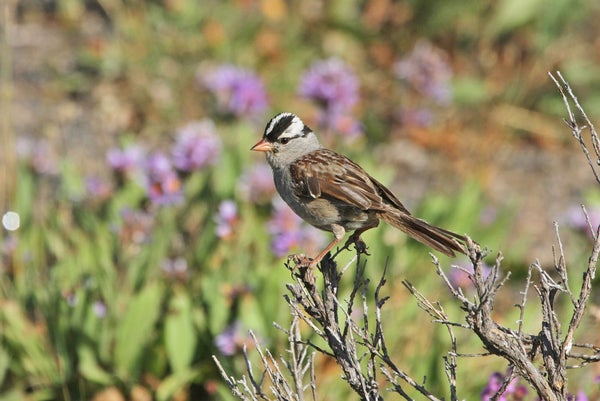
Some sparrows, a new study finds, are remarkably picky about which songs they sing, showing a clear preference for melodies sung by birds of the exact same feather. Indeed, Douglas Nelson of Ohio State University reports in today's issue of the Proceedings of the National Academy of Sciences that male mountain white-crowned sparrows have a genetic predisposition to memorize and learn songs of their own subspecies, compared with the tunes of all other white-crowned sparrows. "While scientists had known that birds prefer to learn the songs of their own species over those of another species when first exposed to them," Nelson commented, "this study shows birds have an even more specific preference for their own subspecies song."
Nelson and his colleagues collected 28 four- to seven-day-old mountain white-crowned sparrows (Zonotrichia leucophrys oriantha) from the California Sierra Nevada and brought them to the lab. Nearly a week later, they let the baby birds hear songs recorded from their own species and those from Nuttall's white-crowned sparrows, a species that lives some 200 kilometers from the fledglings' nesting site. All of them chirped more when they listened to the mountain white-crowned sparrow songs. Next they tutored the birds for 10 days, playing recordings from both groups repeatedly. This time, the birds chirped more upon hearing songs they were taught, regardless of the subspecies. "However, when you compared the level of chirping, birds who learned the Nuttall's song still chirped quite a bit to the song of their own mountain species," Nelson said. Birds taught their native song didn't respond as much to the other tunes.
Finally, the researchers taught all the birds all of the songs for 40 days, hoping to find out which songs the birds would choose to sing of all the melodies they knew. Nine months later, when the birds were old enough to begin singing, 67 percent sang mountain white-crowned sparrow songs. "Because two thirds of the birds chose their own subspecies' song, it suggests that they have a genetic predisposition to learn and sing that song," Nelson adds. Further work showed that without tutoring, the birds did not discriminate between different dialects in their own subspecies' songs.