
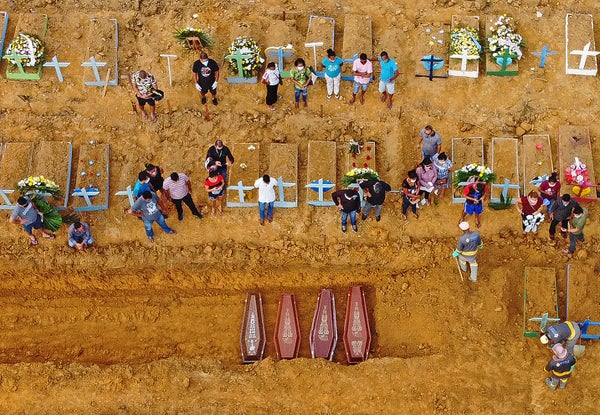
To judge by popular movies, people who live in the Brazilian Amazon are at constant risk of being attacked by huge tarantulas, squeezed to death by giant anacondas and being eaten alive by voracious piranhas. In fact, the real dangers have more to do with tropical diseases such as malaria, cholera, dengue, yellow fever and chikungunya. And while illnesses would be mostly preventable through modern sanitation and hygiene measures, these are mostly unavailable.
Take Porto Velho, for example—a city of half a million people and the capital of the state of Rondônia, in the heart of the Brazilian Amazon, where fewer than 1 percent of residences have access to treated water and proper sewerage. And rather than take responsibility for these conditions, TV ads created by the government blame the population itself for disease outbreaks, as if the lack of hygiene were a cultural characteristic and not a matter of failed public policies.
The same sort of abdication of responsibility occurs when nearby farmers outside the city burn the forest to create pastureland for cattle. Despite the increase in hospital admissions, especially of children, resulting from respiratory problems caused by the smoke, the official position is that the wildfires are inevitable because of “development.” This is technically correct: without the fires, there would be no cattle to export, and without cattle, the ranch owners wouldn’t have enough money to donate to the politicians (or to keep for themselves, because many of the ranch owners are politicians).
On supporting science journalism
If you're enjoying this article, consider supporting our award-winning journalism by subscribing. By purchasing a subscription you are helping to ensure the future of impactful stories about the discoveries and ideas shaping our world today.
And now, with the arrival of COVID-19, we are seeing a similar pattern. By late July, there were more than 800 deaths from the coronavirus in Rondônia. But COVID-19 has become an ideological issue, not just a public health problem. Whether or not people wear protective masks or practice self-isolation depends on whether they support President Jair Bolsonaro, who has consistently downplayed the dangers of the pandemic. The official line is that the economic disruption that would result from aggressive measures against the disease would take more lives than the virus itself. (Bolsonaro tested positive himself recently, although according to an official statement he remained in good condition.)
The illness in Porto Velho reflects what we already know about disease in the Brazilian Amazon: the poorest are most at risk. When we cross-check mobility data provided by Google; data from the state’s Health Department; and social indicators such as the United Nations Human Development Index (HDI) on access to sanitation, education and employment, it becomes clear that areas in Porto Velho where compliance with self-isolation falls below 30 percent are also the poorest ones and those in which there is a greater number of confirmed COVID-19 confirmed cases.
In short, the poorest people are the sickest. We may understand these data in two ways. The first interpretation, advanced by public administrators at the state level, is that it’s their own fault that the poorest people are seeing the most illness. But poor housing, malnutrition and lack of formal employment are clearly not their fault. These conditions mean that the poor are unable to isolate themselves socially, wash their hands or buy protective masks. They have little access to public health resources and social assistance.
The challenge becomes to understand the structural factors that maintain these inequalities and their consequences for people’s health, and to begin to remedy them. Only then will these communities no longer have to choose between working and putting themselves and their families at risk on one hand, versus self-isolating and starving.