
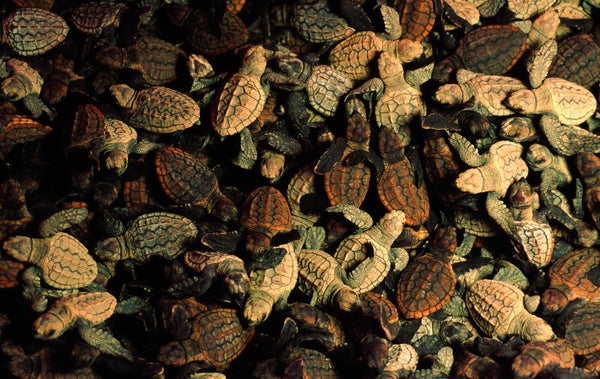
Determining turtle hatchlings' sexes is a challenging but critical task. For many species the embryo's sex development depends on environmental temperatures, and rising heat is producing overabundances of females and shortages of males. Unchecked, this mismatch could push some species toward extinction.
To save them, “you have to really understand where the problems lie,” says Jeanette Wyneken, a biologist at Florida Atlantic University and senior author on a new study on the topic, published in March in Scientific Reports. Monitoring turtles' sex ratios as hatchlings can help—but species with temperature-dependent sex determination lack sex chromosomes and mature relatively late, making their sexes hard to discover noninvasively.
Wyneken's team developed a blood test that determined the sexes of loggerhead and red-eared slider hatchlings up to two days old with 100 percent accuracy. In older juvenile loggerheads, the results were 90 percent accurate. The test checked a tiny blood sample for a hormone that prevents young males from developing oviducts. (The hormone takes on additional roles as the turtles grow, Wyneken says, which can complicate results for older females.)
On supporting science journalism
If you're enjoying this article, consider supporting our award-winning journalism by subscribing. By purchasing a subscription you are helping to ensure the future of impactful stories about the discoveries and ideas shaping our world today.
The researchers then used two standard techniques to verify results for the turtles they tested. They analyzed tissue samples from gonads of their 10 red-eared sliders, which were sacrificed as hatchlings, and five loggerheads, which were found dead in their nest boxes. They also raised 54 loggerhead juveniles to between 83 and 177 days old before performing laparoscopic surgeries on the live animals. These surgeries cannot be safely performed on hatchlings, Wyneken says.
The group is working to make the blood test field-ready. The researchers hope to use it to monitor sex ratios in easy-to-catch wild hatchlings and perhaps find ways to intervene in the field, such as providing shade or cooling sprinklers when eggs are incubating. Unlike current methods, which require killing hatchlings or estimating sex ratios based on incubation temperature, the new technique “is a nonlethal and reliable method to determine hatchling sex,” says Camryn Allen, a wildlife endocrinologist at the Pacific Island Fisheries Science Center, who was not involved with the study.