
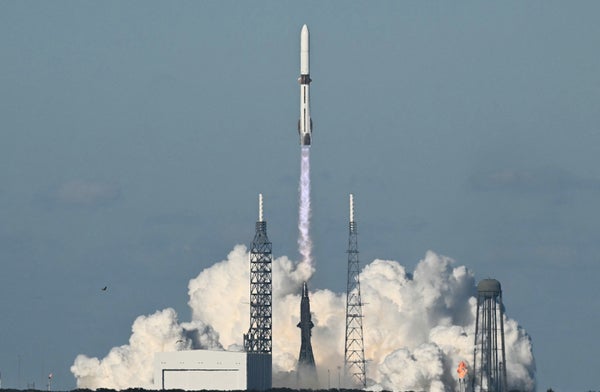
Blue Origin successfully launched—and partially landed—its New Glenn rocket on Thursday. The achievement marks a major step forward in the company’s bid to rival SpaceX as a reliable provider of reusable rockets for NASA and other government agencies.
The rocket took off from Cape Canaveral, Fla., at 3:55 P.M. EST, with NASA’s ESCAPADE mission to study how space weather affects Mars onboard. Somewhat ironically, space weather was also the cause of the mission’s latest delays; a severe solar storm on Wednesday made conditions in Earth orbit too risky to attempt a planned launch at that time. The rocket’s reusable first stage, dubbed “Never Tell Me the Odds,” touched back down minutes later on a Blue Origin drone ship—a first for the company.
New Glenn’s flight represented a test for Blue Origin; the company has long sought to compete with SpaceX’s fully reusable rockets, which have dominated the global launch market. During New Glenn’s inaugural flight in January, the company failed to land the rocket’s first stage on its oceanic barge. After today’s successful landing, Blue Origin is much better positioned to win lucrative launch contracts—including some for NASA’s upcoming moon missions that were recently been put back on the table after they had originally gone to SpaceX.
On supporting science journalism
If you're enjoying this article, consider supporting our award-winning journalism by subscribing. By purchasing a subscription you are helping to ensure the future of impactful stories about the discoveries and ideas shaping our world today.
Elon Musk’s rocket company is lagging behind on development for its Starship megarocket, which NASA had hoped to use to ferry astronauts to and from lunar orbit to the moon’s surface as part of the Artemis III mission slated for 2027. In October, however, NASA’s acting administrator Sean Duffy said the agency would reopen competition for the mission’s crewed lander—creating a potential opening for Blue Origin and other aerospace firms.
Days ahead of Thursday’s launch, Blue Origin’s CEO Dave Limp told Ars Technica that the company “would move heaven and Earth” to help NASA meet its goal of returning people to the moon as soon as possible.