
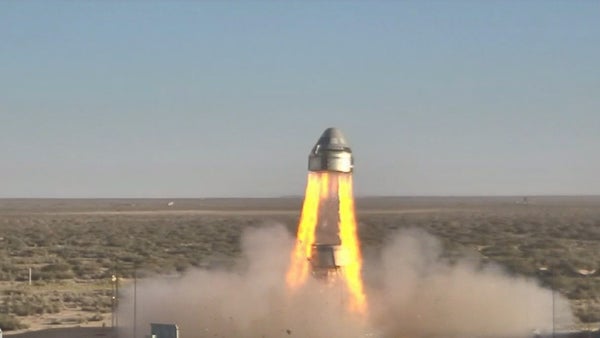
Boeing’s CST-100 Starliner crewed vehicle aced a crucial safety test this morning (Nov. 4) in the New Mexico desert.
Called a pad abort test, the drill checked the vehicle’s ability to carry astronauts to safety should engineers notice an anomaly with the rocket that could endanger a launch. That scenario means that during a pad abort test, the capsule has to quickly pick up enough speed to carry humans to safety, starting from a standstill.
“That was phenomenal,” Boeing spokesperson Jessica Landa said during a live broadcast of the test. “Initial indication is we’ve had a very successful pad abort test today.”
On supporting science journalism
If you're enjoying this article, consider supporting our award-winning journalism by subscribing. By purchasing a subscription you are helping to ensure the future of impactful stories about the discoveries and ideas shaping our world today.
The test occurred on Launch Complex 32 at White Sands Missile Range in New Mexico. The Boeing team had arranged for a three-hour launch window for the test, although the capsule was only in the air for a little over a minute. The launch occurred at 7:15 a.m. local time (9:15 a.m. EST, 1415 GMT).
All three astronauts who will fly on Starliner’s first crewed launch, a demonstration mission to the International Space Station, were present at today’s test.
“We hope we never need to use this system,” NASA astronaut Mike Fincke said. “We know after today’s test we’ll be able to get off safely and come back and try another day.”
Boeing is hoping the trio will fly next year. “It’s starting to feel really close, it’s amazing, especially being here for the test,” NASA astronaut Nicole Mann said. “Big milestones like the test today are just showing that we’re getting a lot closer.”
For today’s test maneuver, the capsule was equipped with an anthropomorphic test dummy equipped with sensors to gather data that will help Boeing engineers evaluate the results of the test.
During the test, the Starliner capsule was programmed to reach a speed of 650 mph (1,046 km/h) in just 5 seconds. Engines on board the spacecraft fired intermittently over the course of 10 seconds in order to carry the capsule away from the launch pad and the hypothetical unstable rocket.
“I hope you didn’t blink!” Landa said. “That thing sure did shoot off the test stand, didn’t it?”
Then, the spacecraft oriented itself and a suite of parachutes released in three pulses over the course of about 25 seconds. The parachutes are crucial for crew safety because they both slow the capsule down and orient the spacecraft for a safe landing.
Those parachutes come in three pulses: two drogue parachutes, three pilot parachutes and three main parachutes. Only two of the last category deployed during today’s test, but that is within the range of acceptable safety conditions for the vehicle, Landa said.
About 60 seconds into the procedure, the Starliner capsule jettisoned its heat shield and deployed airbags to soften the landing still further.
The Starliner capsule is designed to return crew members to land, in part to make the vehicle more easily reused, according to Landa. However, during a real pad abort, from Starliner’s launch site in Florida, a pad abort would trigger a landing over the Atlantic Ocean.
Today’s test took place on the same stand where NASA’s Orion crew capsule conducted the same drill a few years ago, according to NASA spokesperson Dan Huot.
Boeing’s next launch for the Starliner vehicle, its uncrewed demonstration mission to the International Space Station, is scheduled for Dec. 17 from Florida.
Copyright 2019 SPACE.com, a Purch company. All rights reserved. This material may not be published, broadcast, rewritten or redistributed.