Bonobos Might Not Be So Laid-Back after All

The apes may focus on dominance rather than morality when it comes to interpreting social behaviors

bonobos

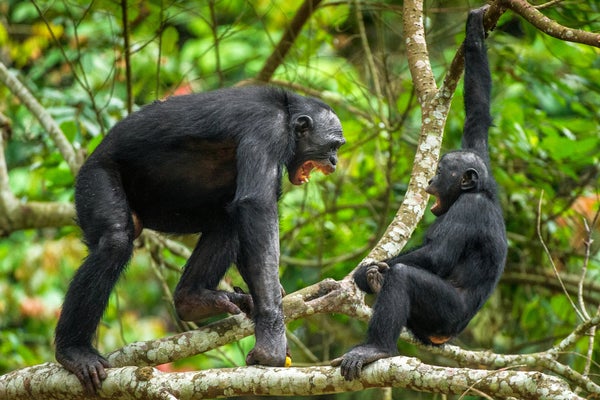
Unlike their human cousins, bonobos favor others that throw their weight around.

Join Our Community of Science Lovers!

Given a choice, most humans would probably rather spend time with nice people than with jerks. But the opposite seems to be true of bonobos, a recent study suggests.

“Of our two closest relatives, chimps and bonobos, [bonobos] are the ones known to show less extreme aggression,” says the study's lead author Christopher Krupenye, an evolutionary anthropologist now at the University of St. Andrews in Scotland. “So we thought, if either of them are likely to share with humans this motivation to prefer helpers, it may be bonobos.”

Krupenye and Duke University anthropologist Brian Hare tested a group of 43 bonobos living in a sanctuary in the Democratic Republic of the Congo. In one experiment, 24 bonobos watched a series of cartoons depicting an anthropomorphic circle trying to ascend a hill. The circle was either helped by a triangle or hindered by a square. The apes were then offered two identical pieces of fruit under a paper cutout of either the “helper” triangle or the “hinderer” square. Like human infants, bonobos could distinguish each shape on the basis of its social behaviors. But unlike humans, they preferred the square. The findings appeared in January in Current Biology.


On supporting science journalism

If you're enjoying this article, consider supporting our award-winning journalism by subscribing. By purchasing a subscription you are helping to ensure the future of impactful stories about the discoveries and ideas shaping our world today.


Behaviors humans see as antisocial might, among bonobos, be more reflective of social dominance. And for apes living in a strict hierarchy, it pays to befriend those on top. Krupenye says his team's results support the notion that the preference to avoid individuals who mistreat others is one of the things that set humans apart from other apes. But University of Southern California developmental psychologist Henrike Moll, who was not involved in the study, argues it may not make sense to compare the two species this deeply on the basis of their reactions to these videos—especially if humans interpret them in terms of morality, whereas bonobos view them through the lens of social dominance.

Jason G. Goldman is a science journalist based in Los Angeles. He has written about animal behavior, wildlife biology, conservation, and ecology for Scientific American, Los Angeles magazine, the Washington Post, the Guardian, the BBC, Conservation magazine, and elsewhere. He contributes to Scientific American's "60-Second Science" podcast, and is co-editor of Science Blogging: The Essential Guide (Yale University Press). He enjoys sharing his wildlife knowledge on television and on the radio, and often speaks to the public about wildlife and science communication.

More by Jason G. Goldman
Scientific American Magazine Vol 318 Issue 4This article was published with the title “Bonobos Like Bullies” in Scientific American Magazine Vol. 318 No. 4 (), p. 14
doi:10.1038/scientificamerican0418-14

It’s Time to Stand Up for Science

If you enjoyed this article, I’d like to ask for your support. Scientific American has served as an advocate for science and industry for 180 years, and right now may be the most critical moment in that two-century history.

I’ve been a Scientific American subscriber since I was 12 years old, and it helped shape the way I look at the world. SciAm always educates and delights me, and inspires a sense of awe for our vast, beautiful universe. I hope it does that for you, too.

If you subscribe to Scientific American, you help ensure that our coverage is centered on meaningful research and discovery; that we have the resources to report on the decisions that threaten labs across the U.S.; and that we support both budding and working scientists at a time when the value of science itself too often goes unrecognized.

In return, you get essential news, captivating podcasts, brilliant infographics, can't-miss newsletters, must-watch videos, challenging games, and the science world's best writing and reporting. You can even gift someone a subscription.

There has never been a more important time for us to stand up and show why science matters. I hope you’ll support us in that mission.

Thank you,

David M. Ewalt, Editor in Chief, Scientific American

Subscribe