Book Review: Beneath the Surface

Books and recommendations from Scientific American

Join Our Community of Science Lovers!


On supporting science journalism

If you're enjoying this article, consider supporting our award-winning journalism by subscribing. By purchasing a subscription you are helping to ensure the future of impactful stories about the discoveries and ideas shaping our world today.


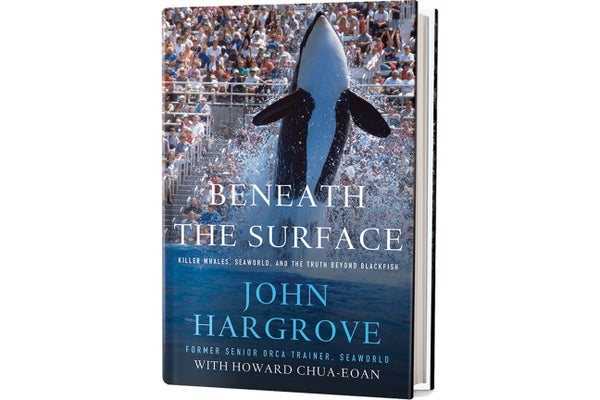
Beneath the Surface: Killer Whales, SeaWorld, and the Truth Beyond
by John Hargrove , with Howard Chua-Eoan
Palgrave Macmillan*, 2015 ($26)

Since his first visit to SeaWorld as a young boy, Hargrove dreamed of working with orcas. Eventually he got his wish and became a senior trainer there, caring for killer whales over 14 years. As Hargrove's love for and knowledge of the creatures increased, however, he gradually concluded that the work he was part of at SeaWorld was harming them and was unacceptably dangerous to himself and the other human trainers. Orcas are too big and too intelligent to be kept in captivity, Hargrove argues, and he came to see the daily “Shamu Stadium” shows where the whales perform tricks as “part of a rapacious corporate scheme that exploited both the orcas and their human trainers.” He resigned from SeaWorld in 2012 and appeared in the documentary Blackfish, which criticized the park's practices after its trainer Dawn Brancheau was killed by a whale in 2010. Here Hargrove covers both the joy of his own experiences with orcas as well as the case for why such interactions in captivity should end.

MORE TO EXPLORE
For more recommendations, go to ScientificAmerican.com/mar2015/recommended

Scientific American Magazine Vol 312 Issue 3This article was published with the title “Beneath the Surface” in Scientific American Magazine Vol. 312 No. 3 (), p. 72
doi:10.1038/scientificamerican0315-72a

It’s Time to Stand Up for Science

If you enjoyed this article, I’d like to ask for your support. Scientific American has served as an advocate for science and industry for 180 years, and right now may be the most critical moment in that two-century history.

I’ve been a Scientific American subscriber since I was 12 years old, and it helped shape the way I look at the world. SciAm always educates and delights me, and inspires a sense of awe for our vast, beautiful universe. I hope it does that for you, too.

If you subscribe to Scientific American, you help ensure that our coverage is centered on meaningful research and discovery; that we have the resources to report on the decisions that threaten labs across the U.S.; and that we support both budding and working scientists at a time when the value of science itself too often goes unrecognized.

In return, you get essential news, captivating podcasts, brilliant infographics, can't-miss newsletters, must-watch videos, challenging games, and the science world's best writing and reporting. You can even gift someone a subscription.

There has never been a more important time for us to stand up and show why science matters. I hope you’ll support us in that mission.

Thank you,

David M. Ewalt, Editor in Chief, Scientific American

Subscribe