
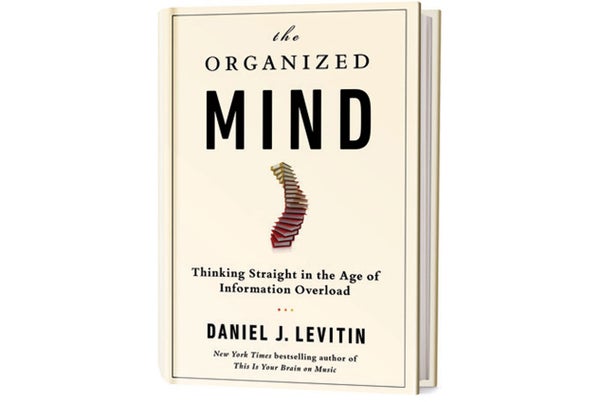
Brain Drain: The Organized Mind
by Daniel J. Levitin
Penguin, 2014 ($27.95)
The subtitle of The Organized Mind is “Thinking Straight in the Age of Information Overload.” If you are hoping this lengthy book (512 pages) will help you do that, think again.
Instead of helping you focus, Levitin, a professor of psychology and music at McGill University, makes your head spin by rambling unevenly and inexplicably over the entire range of topics you would find in almost any introductory psychology text. He even includes the mandatory passages on why correlation does not imply causation.
On supporting science journalism
If you're enjoying this article, consider supporting our award-winning journalism by subscribing. By purchasing a subscription you are helping to ensure the future of impactful stories about the discoveries and ideas shaping our world today.
This is where the book truly disappoints. Rather than simply giving us straight talk about how disorganized our thoughts and lives are (but we knew that) and how we can do better (tell us, please!), Levitin insists on informing us repeatedly and in detail about how various regions or pathways in the brain are “involved in” the various cognitive and behavioral phenomena he surveys. He really means that increased neural activity in these areas of the brain is correlated with certain behavioral and cognitive phenomena, which actually means only that such activity tends to occur at about the same time as the behavioral and cognitive phenomena. That is not saying much, which is why Levitin keeps implying more with that vague phrase, “involved in.”
University of Pennsylvania law professor Stephen Morse has dubbed this practice the “brain overclaim syndrome”—the pathological tendency to fool people into thinking you have a profound understanding of something by pointing to brain studies. It goes without saying that any distinctive thing we do—raising an arm, thinking of sheep or shouting, “Hooray!”—must be accompanied by some corresponding neural activity, but that does not explain the activity.
On the practical side, the book contains a dozen or so tips to help you get organized, but you have to work hard to find them, and there are none you have not heard before: stay focused, go to bed the same time every night, stay mentally active, avoid multitasking, divide complex tasks into “chunks,” write things down (especially on index cards), do not procrastinate, exercise regularly and, of course, prioritize.
Although these are sound tips, Levitin's lengthy expositions and neuroscientific rationales do not ring any more true than the justifications your parents or grandparents gave you when they offered similar advice, and some of them have been around since the days of Samuel Smiles's popular book, Self-Help, which was published the same year Charles Darwin published On the Origin of Species.
If you want to get your head organized, you are better off with leaner, meaner books, such as David Allen's practical and focused best seller, Getting Things Done: The Art of Stress-Free Productivity (from which Levitin borrows openly), Ori and Rom Brafman's playful primer, Sway: The Irresistible Pull of Irrational Behavior, or Gerd Gigerenzer's latest tour de force on clear thinking, Risk Savvy: How to Make Good Decisions.