On supporting science journalism
If you're enjoying this article, consider supporting our award-winning journalism by subscribing. By purchasing a subscription you are helping to ensure the future of impactful stories about the discoveries and ideas shaping our world today.
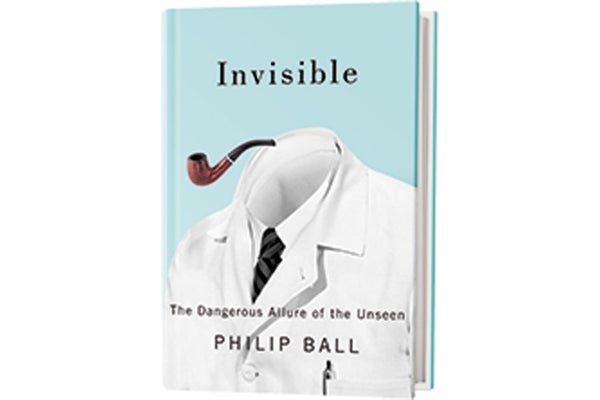
Invisible: The Dangerous Allure of the Unseen
by Philip Ball
University of Chicago Press, 2015 (($27.50))
Humans have always imagined the invisible—whether spirits that are summoned or appeased, intangible ether suffusing the universe, or x-rays, magnetic forces and microbes that can be put to work. Science writer Ball takes readers through history to show how myths and legends of the invisible, along with the science of each time period, have influenced our quest to understand what we cannot see. His narrative explores the earliest spells and recipes for supposedly creating or penetrating invisibility, and it recalls disappearance illusions on stage, screen and battlefield, as well as humankind's many theories about invisible entities both real and imagined—such as germs, ghosts and dark matter. Finer tools and measurements through the ages have made our understanding of the imperceptible particles and forces in the world much more precise and actionable—but no less astonishing.
Subscribe to Support Independent Journalism
Great science journalism requires human expertise, time, effort and creativity. And it costs money. That’s why I and the journalists here at Scientific American hope you’ll join our community.
When you subscribe, you are supporting staff and freelance journalists who are passionate about telling science stories that are true, important and compelling. Our editors and reporters are often experts in their fields, which means they understand the nuances of big discoveries and can untangle the breakthroughs from the hype. With a subscription, you are also supporting rigorous fact-checking to ensure the words we publish are precise and accurate. And you’re supporting original illustrations, graphics and photos that bring you closer to an advanced laboratory, an ice sheet in Antarctica or a space mission in orbit. You’re helping us craft other types of high-quality journalism as well: Our newsletters are carefully written, edited and curated by staffers you have or will come to know and love. Our Science Quickly podcast is based on original reporting, collaboration with editors and scientists and exacting production.
Subscriptions keep this engine running so we can continue to deliver thoughtful, rigorous and independent science journalism to you. In an era of viral misinformation, this work is crucial. If you value what we do, I hope you’ll consider joining us as a subscriber