
On supporting science journalism
If you're enjoying this article, consider supporting our award-winning journalism by subscribing. By purchasing a subscription you are helping to ensure the future of impactful stories about the discoveries and ideas shaping our world today.
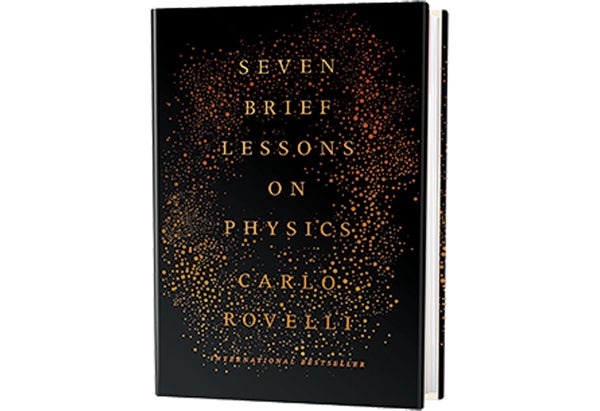
Seven Brief Lessons on Physics
by Carlo Rovelli
Riverhead Books, 2016 ($18)
This small book—fewer than 100 pages—contains some large ideas. In a series of translated essays first published in an Italian newspaper, theoretical physicist Rovelli, one of the founders of a popular theory called loop quantum gravity, explains the major concepts of modern physics. His concise and comprehensible writing makes sense of intricate notions such as general relativity, quantum mechanics, cosmology and thermodynamics. Rovelli's enthusiastic and poetic descriptions communicate the essence of these topics without getting bogged down in details.
He also comments on the scientific merit of humility, noting that Albert Einstein began an early passage in a seminal paper on the quantization of light with the phrase “It seems to me” and that Charles Darwin introduced some of his great ideas on evolution with the words “I think”—sentiments that Rovelli sums up by observing, “Genius hesitates.