Book Review: The Genius of Birds
Recommendations from Scientific American
By Jennifer Hackett
On supporting science journalism
If you're enjoying this article, consider supporting our award-winning journalism by subscribing. By purchasing a subscription you are helping to ensure the future of impactful stories about the discoveries and ideas shaping our world today.
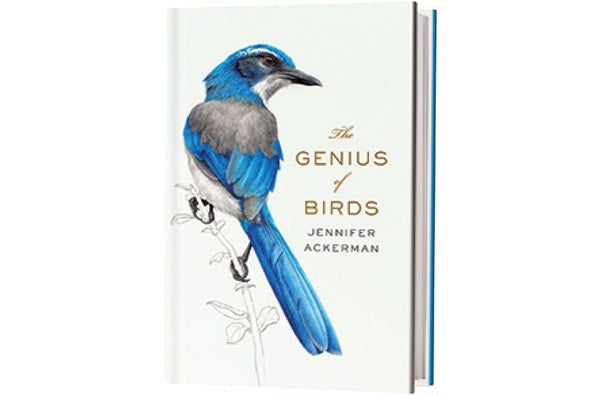
The Genius of Birds
by Jennifer Ackerman
Penguin Press, 2016 ($28)
Science journalist Ackerman sets out to show that being called a “birdbrain” should be a compliment, not an insult. Birds' clever social and environmental problem-solving skills, she shows, establish them among the most intelligent members of the animal kingdom. Crows frequently steal the show: for example, they craft tools, such as branching twigs perfectly pruned into solitary sticks that can retrieve meat from plastic tubes. Even birdsong is cause for admiration: some birds' ability to hear a sound and re-create it has much in common with our own capacity to learn language.
Ackerman devotes each chapter to a different bird skill and ends the book with a discussion of avian adaptive capabilities, which will prove vital in the near future as climate change and loss of habitat have put more than half of North American bird species at risk, according to the Audubon Society.
Subscribe to Support Independent Journalism
Great science journalism requires human expertise, time, effort and creativity. And it costs money. That’s why I and the journalists here at Scientific American hope you’ll join our community.
When you subscribe, you are supporting staff and freelance journalists who are passionate about telling science stories that are true, important and compelling. Our editors and reporters are often experts in their fields, which means they understand the nuances of big discoveries and can untangle the breakthroughs from the hype. With a subscription, you are also supporting rigorous fact-checking to ensure the words we publish are precise and accurate. And you’re supporting original illustrations, graphics and photos that bring you closer to an advanced laboratory, an ice sheet in Antarctica or a space mission in orbit. You’re helping us craft other types of high-quality journalism as well: Our newsletters are carefully written, edited and curated by staffers you have or will come to know and love. Our Science Quickly podcast is based on original reporting, collaboration with editors and scientists and exacting production.
Subscriptions keep this engine running so we can continue to deliver thoughtful, rigorous and independent science journalism to you. In an era of viral misinformation, this work is crucial. If you value what we do, I hope you’ll consider joining us as a subscriber