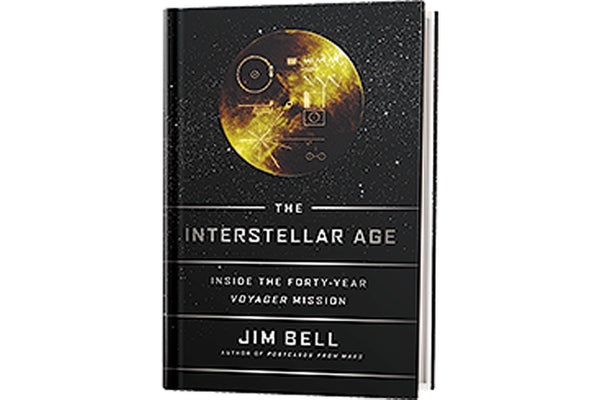
The Interstellar Age: Inside the Forty-Year Voyager Mission
by Jim Bell
Dutton, 2015 (($27.95))
The twin Voyager space probes, launched by NASA in 1977, have traveled farther into the cosmos than any other human-made machine. Now about 19.5 billion kilometers from home, Voyager 1 became the first spacecraft to exit the solar system in 2013. Voyager 2 should follow this year. Their mission was not just to visit outer planets that people had never seen up close but to be emissaries to the universe for Earth's citizens. Both craft carried “golden records” loaded with pictures and sounds—from whale songs to Bach to Chuck Berry—to represent our planet to any extraterrestrial beings who might encounter them. Planetary scientist Bell, who worked on the mission from the time he was an undergraduate, chronicles the two probes' journeys, their revelations about our solar system, and the many people who have dedicated their careers to the mission.
MORE TO EXPLORE
On supporting science journalism
If you're enjoying this article, consider supporting our award-winning journalism by subscribing. By purchasing a subscription you are helping to ensure the future of impactful stories about the discoveries and ideas shaping our world today.
For more recommendations and an interview with author Jim Bell, go to ScientificAmerican.com/feb2015/recommended
Subscribe to Support Independent Journalism
Great science journalism requires human expertise, time, effort and creativity. And it costs money. That’s why I and the journalists here at Scientific American hope you’ll join our community.
When you subscribe, you are supporting staff and freelance journalists who are passionate about telling science stories that are true, important and compelling. Our editors and reporters are often experts in their fields, which means they understand the nuances of big discoveries and can untangle the breakthroughs from the hype. With a subscription, you are also supporting rigorous fact-checking to ensure the words we publish are precise and accurate. And you’re supporting original illustrations, graphics and photos that bring you closer to an advanced laboratory, an ice sheet in Antarctica or a space mission in orbit. You’re helping us craft other types of high-quality journalism as well: Our newsletters are carefully written, edited and curated by staffers you have or will come to know and love. Our Science Quickly podcast is based on original reporting, collaboration with editors and scientists and exacting production.
Subscriptions keep this engine running so we can continue to deliver thoughtful, rigorous and independent science journalism to you. In an era of viral misinformation, this work is crucial. If you value what we do, I hope you’ll consider joining us as a subscriber