New Issue: Orbital Catastrophe Ahead? Read Now

Bosnian Croat General Dies After Drinking Poison in Courtroom

He consumed the substance seconds after his appeal against his war crime sentence was denied

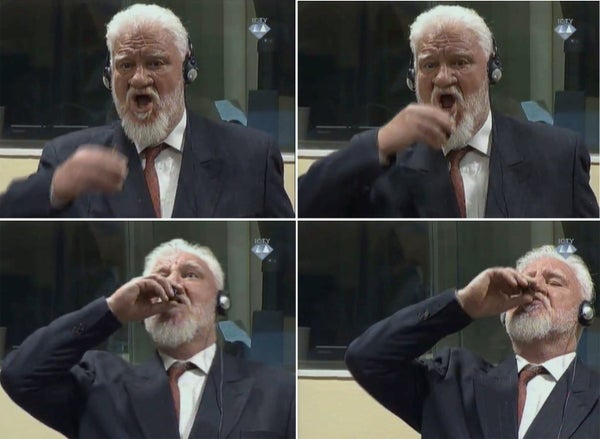
Croatian Former General Slobodan Praljak drinking a small bottle of liquid claimed to be poison after judges reconfirmed his 20-year prison sentence during a Yugoslav War Crimes Tribunal in The Hague, Netherlands on November 29, 2017. 

Join Our Community of Science Lovers!

ZAGREB, Nov 29 (Reuters) - The wartime commander of Bosnian Croat forces, Slobodan Praljak, died after he drank poison seconds after United Nations judges turned down his appeal against a 20-year sentence for war crimes against Bosnian Muslims, Croatian state television reported.

The broadcaster quoted sources close to Praljak as saying he had died in a hospital in The Hague on Wednesday.

Appeals judges at the U.N.'s Yugoslav war crimes tribunal upheld the convictions of six Bosnian Croats found guilty of war crimes and crimes against humanity during the 1990s, in the court's last verdict before it closes next month.


On supporting science journalism

If you're enjoying this article, consider supporting our award-winning journalism by subscribing. By purchasing a subscription you are helping to ensure the future of impactful stories about the discoveries and ideas shaping our world today.


After the judge confirmed his sentence, Praljak, 72, took a swing from a glass and said: "I just drank poison." He also said: "I am not a war criminal. I oppose this conviction."

The presiding judge suspended the hearing and called for a doctor. An ambulance was at the building and paramedics went to the courtroom.

"Former head of the chief headquarters of the Croatian Defence Council, General Slobodan Praljak, died in a hospital in The Hague after he drank poison in a courtroom after the International Criminal Tribunal for the Former Yugoslavia confirmed his 20-year sentence for war crimes," Croatian TV said.

Subscribe to Support Independent Journalism

Great science journalism requires human expertise, time, effort and creativity. And it costs money. That’s why I and the journalists here at Scientific American hope you’ll join our community.

When you subscribe, you are supporting staff and freelance journalists who are passionate about telling science stories that are true, important and compelling. Our editors and reporters are often experts in their fields, which means they understand the nuances of big discoveries and can untangle the breakthroughs from the hype. With a subscription, you are also supporting rigorous fact-checking to ensure the words we publish are precise and accurate. And you’re supporting original illustrations, graphics and photos that bring you closer to an advanced laboratory, an ice sheet in Antarctica or a space mission in orbit. You’re helping us craft other types of high-quality journalism as well: Our newsletters are carefully written, edited and curated by staffers you have or will come to know and love. Our Science Quickly podcast is based on original reporting, collaboration with editors and scientists and exacting production.

Subscriptions keep this engine running so we can continue to deliver thoughtful, rigorous and independent science journalism to you. In an era of viral misinformation, this work is crucial. If you value what we do, I hope you’ll consider joining us as a subscriber

Thank you,

Jeanna Bryner, Editor in Chief, Scientific American

Subscribe