
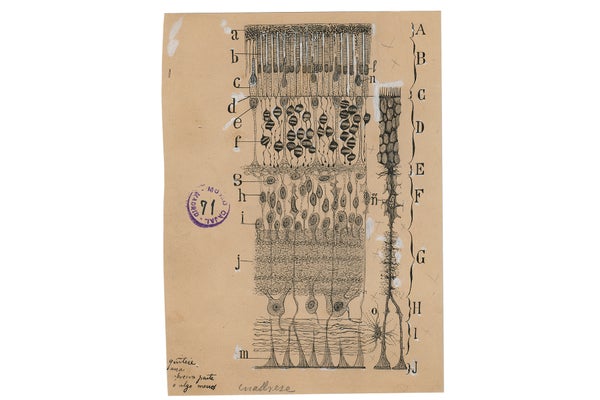
The Beautiful Brain: The Drawings of Santiago Ramón y Cajal
by Larry W. Swanson , Eric A. Newman , Alfonso Araque and Janet M. Dubinsky
Abrams, 2017 ($40)
Often called the “father of modern neuroscience,” Santiago Ramón y Cajal was a Spanish scientist whose exquisitely detailed drawings helped to reveal the pathways, cells and structure of the brain. Born in 1852, Cajal crafted illustrations, based on painstaking observations of brain slices under the microscope, that led to major discoveries long before neuroimaging was possible. He realized, for instance, that the brain was a vast network of individual neurons—a finding that led him to earn a Nobel Prize in 1906. In this large-format book, 82 of Cajal's drawings are paired with commentary and essays from neuroscientists celebrating both the scientific value and the pure artistry of his work.
Storm in a Teacup: The Physics of Everyday Life
by Helen Czerski.
W. W. Norton, 2017 ($26.95)
On supporting science journalism
If you're enjoying this article, consider supporting our award-winning journalism by subscribing. By purchasing a subscription you are helping to ensure the future of impactful stories about the discoveries and ideas shaping our world today.
In an age when any questions we have about the workings of the world are instantly answerable via Google, physicist Czerski pushes us to resist the search engine. Instead of looking up easy explanations, she says, why not learn some simple physics so that you can try to puzzle things out for yourself? Her book provides that knowledge and puts it to work, showing how the laws of physics account for daily phenomena such as why frying food makes it crispy, why drying clothes in damp weather is impossible and why you get electric shocks more often after it snows. “Knowing about some basic bits of physics turns the world into a toybox,” she writes, full of marvels that become more interesting the more we understand them. “A toaster can teach you about some of the most fundamental laws of physics, and the benefit of a toaster is that you've probably got one, and you can see it working for yourself.”
Language at the Speed of Sight: How We Read, Why So Many Can’t, and What Can Be Done about It
by Mark Seidenberg.
Basic Books, 2017 ($28.99)
In recent decades scientists have gained “remarkable consensus” on how our brain learns to read, writes neuroscientist Seidenberg. Then why, he asks, are U.S. literacy levels so low? Poverty and screen usage are big factors, but the way we teach reading is also a major part of the problem, he argues: “Very little of what we've learned about reading as scientists has had any impact on what happens in schools.” For instance, a popular strategy taught to kids who struggle to read a word suggests various guessing strategies, such as thinking of what word might fit in the sentence or looking at illustrations. But these tactics actually distract kids from learning the skills needed to phonetically decode unfamiliar words. Seidenberg reviews the latest science on reading and makes an impassioned plea for putting this knowledge to use.
Earth in Human Hands: Shaping Our Planet’s Future
by David Grinspoon.
Grand Central Publishing, 2016 ($28)
In this overview of the “Anthropocene,” the proposed name for our current geologic epoch, astrobiologist Grinspoon describes how humans are disrupting global ecosystems and places our present situation into a broader cosmic perspective. In flavorful prose, he dives deep into the history of life on Earth (and beyond) and muses on ways that geoengineering, interplanetary colonization or contact with galactic civilizations could define this human-dominated epoch just as much as climate change, overpopulation and resource scarcity. “It took 4.5 billion years for Earth to go from dead rock to space walk, from molten ball to shopping mall, from sea to me, from goo to you,” he writes. What comes next? This hybrid of a meditative memoir, a scientific primer and a call to arms presents possible answers. —Lee Billings
