
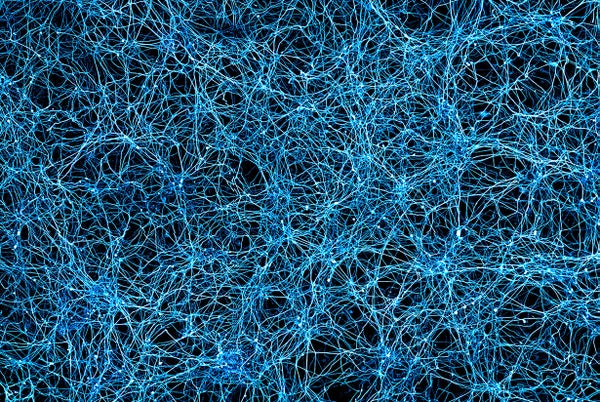
Ironically, this tangle of brain cells is helping scientists tease apart a larger problem: how to help people with Alzheimer’s disease. Matheus Victor, a researcher at the Massachusetts Institute of Technology, photographed these neurons after coaxing them to life in a petri dish in the hope that the rudimentary brain tissue will reveal why a new therapy might alleviate Alzheimer’s symptoms.
In humans and mice, a healthy memory is associated with a high level of synced neurons that turn on and off simultaneously. Those with neurological conditions such as Alzheimer’s and Parkinson’s disease often have fewer brain cells blinking unanimously. A couple of years ago Victor’s lab leader Li-Huei Tsai and her team at M.I.T. found that when they surrounded mice genetically predisposed to Alzheimer’s with sound pulses beating 40 times a second, the rodents performed better on memory-related tasks. The animals also
lost some amyloid plaques, protein deposits in the brain that are characteristic of the disease. The researchers had previously performed a similar study with light flickering at the same rate, and the mice were found to experience additional improvements when the sound and light pulses were combined. Astoundingly, the mouse neurons synced up to the 40-beats-per-second rhythm of the audio pulses, though the mechanism behind this result and the reason the shift improves symptoms remain a mystery. To help solve it, the researchers want to watch how brain tissue responds to the stimulants at the cellular level. The goal is to one day understand how this exposure treatment might work for people, so the team is growing human brain cells in the lab and engineering them to respond to sound and light without eyes and ears. “We are trying to mimic the sensory stimulation in mice but missing a lot of the hardware that makes it possible. So this is a bit of a hack,” Victor says.
On supporting science journalism
If you're enjoying this article, consider supporting our award-winning journalism by subscribing. By purchasing a subscription you are helping to ensure the future of impactful stories about the discoveries and ideas shaping our world today.
The sprawling neurons pictured here started out as skin cells, which Victor reverted back to stem cells and then, using a cocktail of key genetic chemicals, coaxed into a rudimentary brain tissue. The hope is that if labs do this conversion process with skin from people with Alzheimer’s, the final brain cells will resemble an affected individual’s actual brain and might respond to sound and light the same way that the patient would. Victor is carrying out the transformation protocol with skin samples from Alzheimer’s patients who also provided brain samples after death. He will be doing some cross comparisons between the real and petri dish brain cells in the coming months, he says. “Check again with me in a year or two, and I promise I’ll have a better answer for you!” Victor adds.