
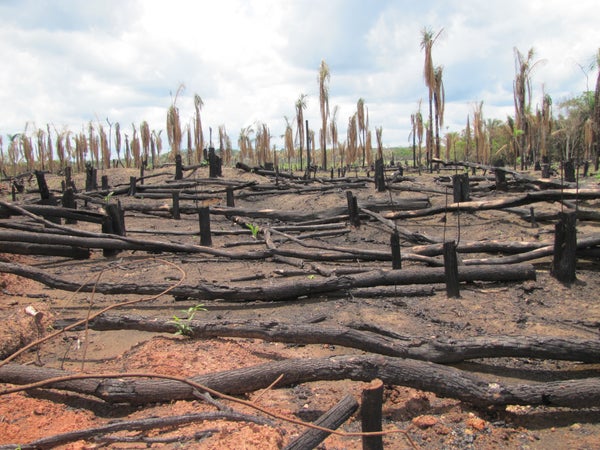
Greenhouse gas emissions jumped 3.5 percent last year due to a rise in forest clearing, according to a report released yesterday from Observatório do Clima, a consortium of 40 environmental groups in Brazil.
The country, in the midst of the deepest economic recession in more than a century, saw its gross domestic product fall 3.8 percent last year. Concurrently, almost 2,400 square miles of forests was lost, the first major jump in deforestation in four years.
The jump in emissions—the country is now at the same emissions level that it had in 2010—has called into question whether the South American country can meet its international climate commitments. The country pledged to cut emissions 37 percent below 2005 levels by 2025 and 43 percent by 2030.
On supporting science journalism
If you're enjoying this article, consider supporting our award-winning journalism by subscribing. By purchasing a subscription you are helping to ensure the future of impactful stories about the discoveries and ideas shaping our world today.
“If emissions rose during a recession, if deforestation increased while the economy was contracting, we wonder what could happen when Brazil resumes economic growth,” said Carlos Rittl, executive secretary of Observatório do Clima.
The data came from the Greenhouse Gas Emission Estimate System, or SEEG, a project of the Brazil climate observatory. It is run by Tasso Azevedo, a well-known Brazilian forest and climate expert, and is open to the public, researchers and journalists.
According to the analysis, in 2015, Brazil emitted 1.927 billion tons of CO2 equivalent, up from 1.861 billion tons in 2014. Deforestation contributed 884 million tons of carbon dioxide equivalents.
Emissions from Brazil’s energy sectors fell by more than 5 percent, as did transportation emissions. The report cited the stagnant economy and growth of renewable energy sources as reasons why emissions fell in those areas.
SEEG’s independent analysis is not the only one to show a jump in emissions from forest clearing. The country’s National Institute for Space Research said in September that the rate of deforestation in the Amazon was up 24 percent in 2015 compared with 2014.
Kathryn Hochstetler, a professor of international development at the London School of Economics and Political Science, said that since 2013, deforestation rates in Brazil stopped falling consistently and have been bouncing around.
The problem is compounded by a drop in federal spending and attention paid to programs and monitoring systems that would address forest loss. The country’s new government, led by Michel Temer and the Brazilian Democratic Movement Party, has shown little appetite for bolstering forest protections, she said.
“So it’s hard to tell if this year’s rise is the beginning of a sharp upward trend, but it’s safe to say that there is still a lot of uncontrolled deforestation there, and the past few years show very little new progress toward changing that,” Hochstetler said.
Pedro Telles, climate change project leader for Greenpeace in Brazil, said in addition to a reduction in funds for forest protection, over the last few years, the government has both weakened laws that protect the Amazon and invested in large infrastructure projects like hydroelectric dams, which can cause major destruction to the forests when constructed.
“It’s becoming increasingly evident, and it has been for a few years, that Brazil’s discourse in international negations where Brazil sees itself as a leader in climate action is distracting from what is happening on the ground,” he said. “The number we have from last year that emissions went up because of deforestation while the economy was going down is just another signal.”
Reprinted from ClimateWire with permission from Environment & Energy Publishing, LLC. E&E provides daily coverage of essential energy and environmental news at www.eenews.net. Click here for the original story.