
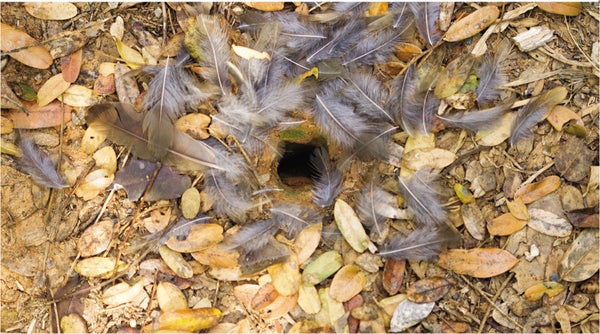
Fallen feathers may appear innocuous, but bugs in tropical Brazilian savannas should think twice about approaching them. New research suggests Pheidole oxyops ants sometimes place feathers around their underground nest's single entrance as bait for other creatures, which then tumble in. This behavior is an unusual example of ants using lures or traps rather than actively hunting down their prey.
Inácio Gomes, an ecologist at the Federal University of Viçosa in Brazil, had never seen any description in scientific studies of ants building traps. He first noticed feathers around ant nest entrances in city parks and on his college campus, and he found two hypotheses in scientific literature: the feathers could collect morning dew in dry areas, or they could act as lures.
Gomes is lead author on an August study in Ecological Entomology that experimentally tested both ideas. The researchers provided a ready supply of wet cotton balls but found the ants still collected feathers, suggesting they were not being used for water. And the team found that artificial traps with feathers around them captured more wandering arthropods than those without.
On supporting science journalism
If you're enjoying this article, consider supporting our award-winning journalism by subscribing. By purchasing a subscription you are helping to ensure the future of impactful stories about the discoveries and ideas shaping our world today.
Gomes says that once prey such as mites, springtails or other species of ants fall in, the nest entrance's soft walls make it hard for them to climb out, and the inhabitants quickly subdue them.
Helen McCreery, a biologist at Harvard University, who was not involved in Gomes's research, says the study is “really cool” and well done. “It's a very charismatic, conspicuous behavior,” McCreery adds. “There are certainly very few examples of ants acquiring food without leaving their nest.”
McCreery wonders why prey are attracted to the feathers in the first place; Gomes suggests smell and shape are potential draws. “In general, soil insects are very curious—that's why pitfall traps are so effective,” Gomes says. Scientists use similar traps to capture wild specimens.
P. oxyops forage alone or in groups like other ant species—Gomes once saw them take down a praying mantis—but he said they most likely supplement hunting with the feather traps to get through long dry seasons with scarcer prey.