
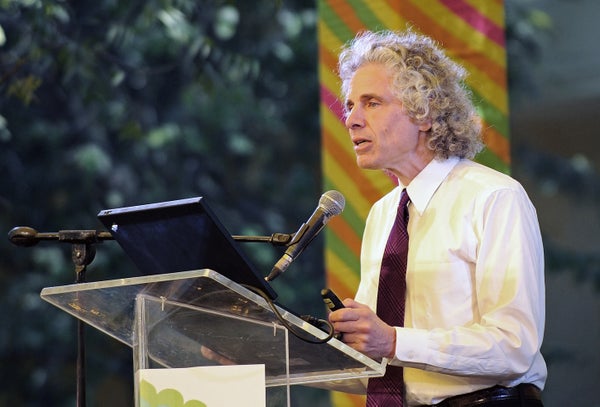
The world is healthier, richer, safer, more equal and generally better off than it was at any other point in time, psychologist Steven Pinker points out. Yet many feel depressed and hopeless about the state of humanity and the problems facing us. Pinker seeks to shake us out of our funk in his new book, Enlightenment Now: The Case for Reason, Science, Humanism and Progress (Viking, 2018). With data, graphs and charts, he highlights the progress humankind has made—arguing the status quo is not actually that bad, or at least is much better than it has ever been—and lays out the reasons for optimism about the future. If we use science, evidence and reason to guide the institutions of democracy, he says, we can continue to improve our world.
Scientific American spoke to Pinker about his own areas of hope and pessimism, the role of the news media and how the latest presidential election has affected his thinking.
[An edited transcript of the conversation follows.]
On supporting science journalism
If you're enjoying this article, consider supporting our award-winning journalism by subscribing. By purchasing a subscription you are helping to ensure the future of impactful stories about the discoveries and ideas shaping our world today.
Your book feels refreshingly optimistic compared with the pessimism and divisiveness that have been so prevalent, especially since the last presidential election. Did you write it before or after Pres. Donald Trump was elected?
The book is a defense of the role of science in human progress, and documenting that progress is actually taking place. Then I had to accommodate what would seem to be a rather glaring counterexample that happened in November 2016. But I had never thought of progress as some mystical force that carries us ever upward. The point of the book right from the start was that progress was the result of embracing the ideals of the Enlightenment: reason, science and humanism. If people set their goal as using knowledge to make people better off, they can allow progress to take place incrementally. Almost as soon as the Enlightenment unfolded there were counter-Enlightenment movements that glorified the tribe, the homeland, the culture; that pushed back against reason as the way to grapple with our world. In many ways Donald Trump is just the representative of the latest counter-Enlightenment movement.
Despite the benefits science has brought, it feels like anti-science attitudes are on the rise. Is science under threat?
Scientific understanding has taken over medicine, agriculture and public health. Policing, even sports, are being increasingly driven by data. Even in many governments evidence is being used to evaluate policies. Of course, there are highly politicized counterexamples, like climate change. On the one hand there is increased use of science and reason in domain after domain, but there are some flaming counterexamples in the political realm.
Does it bother you that most people seem unaware of all the progress you point out, and that so many of us continue to worry that the world is falling apart?
It does upset me that people have become cynical and contemptuous of the institutions of liberal democracy that, for all their flaws, have tremendously improved our lives. It can lead to fatalism—the thought that there’s no point to improving our institutions. It gives an opening to radicalism, to extreme socialism or the Trumpist calls to “drain the swamp” and burn the empire to the ground. In a way the liberal left is agreeing with Trump that every aspect of society is in decline.
You point out that the media is culpable for people’s failure to recognize all the good things that are happening. What should we be doing?
I don’t want to join in the chorus of denunciation of the mainstream media, but I do think there are some bad habits embedded in journalism, which portrays every problem as a crisis or an epidemic—“the end of this,” “the dawn of a post-something era.” This doesn’t mean we should have more heartwarming stories about baby tigers at the zoo, but rather put the events of the day in statistical context. If there is a scandal, a crisis, a failure—How common is it? How common was it in the past? If people can see the sign of the change, whether it’s improved or declined, it would reduce the sense of panic.
And you should follow up on stories that were crises in their day but end up getting solved and result in progress that just never gets reported. There was a brief panic in the late ‘80s about a barge filled with garbage that couldn’t find a landfill to take it. People worried we were overflowing in garbage. It turned out to be fanciful. But people remember the crisis, and they don’t remember the denouement.
In which areas are you most optimistic about progress continuing?
I think we’ll make progress in a number of medical areas like cancer. It’s quite conceivable that there will be effective treatments for Alzheimer’s in the next decade. I think there will continue to be improvements in standards of living in the developing world, and literacy. There’s no reason to think we’ve reached any kind of plateau in technological and knowledge-driven improvements.
And which problems are you most worried about?
We’re clearly not on a path to dealing with climate change. I think our system of nuclear [weapons] stability still has vulnerabilities, and that we, unfortunately, in the last couple months have departed from a pathway toward denuclearization.
What can regular people do if we want to contribute to future progress?
Make a commitment to evidence-based everything and a depoliticization of your thinking as much as possible. There’s far too much groupthink on both the left and the right. And more generally, take a view of the world that doesn’t look at every unsolved problem as an outrage that has to be blamed on some evil perpetrator but rather accepts that problems are inevitable, that the laws of the universe don’t care about us and don’t work in our favor, and that every advance in life and health and wealth is something to celebrate.
The fact that progress has occurred doesn’t mean we can be complacent, but the opposite. Our efforts have a high probability of succeeding.
