
Wind power on Mars is feasible, a new study suggests.
Researchers demonstrated a small, lightweight wind turbine under simulated Martian atmospheric conditions, at the Aarhus Wind Tunnel Simulator II at Aarhus University in Denmark.
Those trials were held in the fall of 2010. The study team reported follow-up findings, and a strong take-home message, in a paper presented at the Mars Workshop on Amazonian and Present Day Climate, which was held last week in Lakewood, Colorado. [7 Biggest Mysteries of Mars]
On supporting science journalism
If you're enjoying this article, consider supporting our award-winning journalism by subscribing. By purchasing a subscription you are helping to ensure the future of impactful stories about the discoveries and ideas shaping our world today.
"For now, we can say for the first time and with certainty, that, YES, you can use wind power on Mars!" the researchers, led by Christina Holstein-Rathlou of Boston University’s Center for Space Physics, wrote in the study.
Realistic conditions
The objective of the wind turbine investigations was to see how much power is produced under realistic Martian atmospheric conditions.
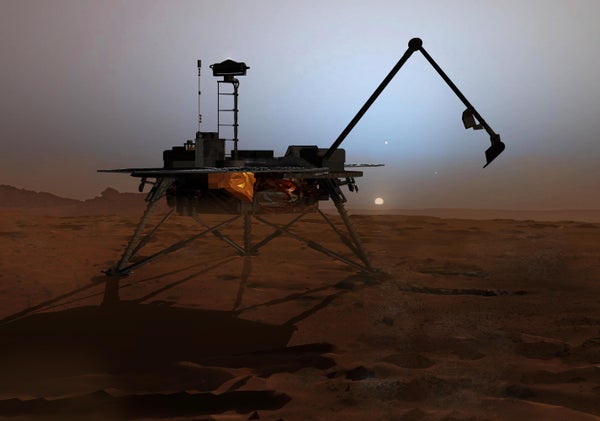
Standard power sources wouldn’t work well for future possible robotic missions to the polar regions of Mars, Holstein-Rathlou and her colleagues noted. Solar cells would have limited or no sunlight for roughly half the year, and the heat expunged by a radioisotope thermoelectric generator (the device that powers NASA’s Curiosity Mars rover and many other deep-space explorers) or similar devices would be detrimental to any science performed in a polar region.
A different possible power source is a wind turbine along with a battery for storing produced electricity, potentially in combination with solar cells, the researchers said.
Blowing in the wind
The concept of a Martian wind turbine has been explored theoretically in connection with human missions to the Red Planet. For example, a 100-kilowatt wind turbine was designed and tested in Antarctica—a general Mars analog site—by researchers from NASA’s Ames Research Center in California.
However, these early concepts were large and heavy and would require substantial wind speeds to be functional, Holstein-Rathlou and her colleagues said. Also, these sizes and masses are unfeasible for science missions to Mars, which are generally relatively small and lightweight, the researchers added.
The 2010 wind-tunnel experiments were run at six different wind speeds. These were based on the most common wind speeds at the far northern landing site of NASA’s Phoenix Mars lander, which touched down in May 2008; the minimum wind speed needed to make the wind turbine rotate; and the maximum wind speed the wings could withstand. (Typical wind speeds on Mars are roughly 4.5 mph to 22 mph, or 7 to 35 km/h.)
For each wind speed, the output voltage was measured for 30-120 seconds.
"The optimal locations for this type of power production are areas where the sun doesn’t always shine, but winds will blow, such as latitudes poleward of the polar circles," the researchers wrote.
A suite of studies still need to be performed before turbine-toting probes are ready to launch toward Mars, the team stressed. However, most designs, singular or part of a system, would be more efficient than the setup tested in the 2010 experiments, and thus should lead to power production in a range that is able to support some or all instrumentation on a small lander, the researchers said.
Copyright 2018 SPACE.com, a Purch company. All rights reserved. This material may not be published, broadcast, rewritten or redistributed.