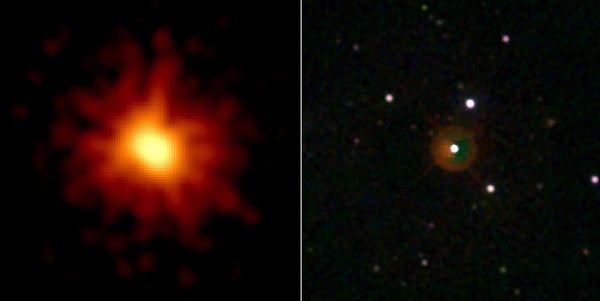
NASA astronomers were blown away last week by what was far and away the strongest gamma-ray burst (GRB) ever observed.
NASA/Swift/Stefan Immler, et al.
Join Our Community of Science Lovers!
On supporting science journalism
If you're enjoying this article, consider supporting our award-winning journalism by subscribing. By purchasing a subscription you are helping to ensure the future of impactful stories about the discoveries and ideas shaping our world today.
NASA astronomers were blown away last week by what was far and away the strongest gamma-ray burst (GRB) ever observed. GRB 080319B, shown here in x-ray [left] and optical/ultraviolet [right] views captured by the Swift satellite, burned so brightly that its afterglow was briefly visible to the naked eye from its origin 7.5 billion light-years (or half a universe) away. If placed side-by-side with the brightest supernova ever seen, the burst would still outshine it by a factor of 2.5 million, researchers calculated. GRBs typically occur when the explosion of a dying star gets channeled into twin high-speed jets. Astronomers are mystified why this one shined so intensely. The burst may simply have been extra powerful or its very narrow jets may have pointed directly at Earth.
It’s Time to Stand Up for Science
If you enjoyed this article, I’d like to ask for your support. Scientific American has served as an advocate for science and industry for 180 years, and right now may be the most critical moment in that two-century history.
SciAm always educates and delights me, and inspires a sense of awe for our vast, beautiful universe. I hope it does that for you, too.
If you subscribe to Scientific American, you help ensure that our coverage is centered on meaningful research and discovery; that we have the resources to report on the decisions that threaten labs across the U.S.; and that we support both budding and working scientists at a time when the value of science itself too often goes unrecognized.