
By Kate Kelland
Britain on Thursday became the first country to formally license an in-vitro fertilization (IVF) treatment designed to create babies from three people.
In a long-awaited decision, Britain's Human Fertilisation and Embryology Authority (HFEA) gave the final go-ahead for the treatment known as mitochondrial transfer, which doctors say could help prevent incurable inherited diseases.
On supporting science journalism
If you're enjoying this article, consider supporting our award-winning journalism by subscribing. By purchasing a subscription you are helping to ensure the future of impactful stories about the discoveries and ideas shaping our world today.
Britain's parliament last year voted to change the law to allow the treatments if and when they were ready for licensing. This latest HFEA decision means the first babies created by the technique in Britain could be born in 2017.
The government's chief scientific adviser, Mark Walport, praised the decision as a "careful and considered" assessment which put Britain at the forefront of medical advances.
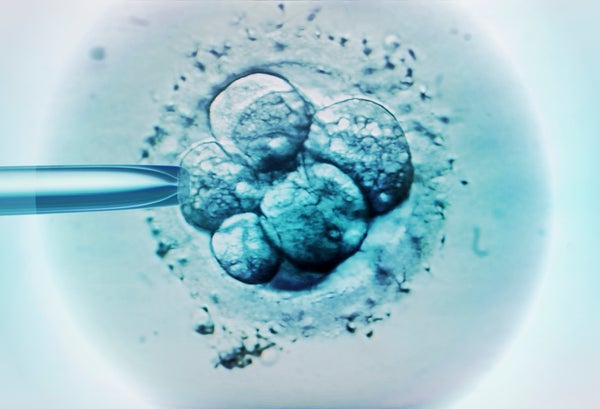
The technique involves intervening in the fertilization process to remove mitochondria, which act as tiny energy-generating batteries inside cells, and which, if faulty, can cause fatal heart problems, liver failure, brain disorders, blindness and muscular dystrophy.
"Mitochondrial donation offers a real opportunity to cure a class of potentially devastating inherited conditions and will bring hope to hundreds of affected families in the UK," said Dagan Wells, a professor at Oxford University's biomedical research center and one of many experts welcoming the decision.
The treatment is known as "three-parent" IVF because the babies, born from genetically modified embryos, would have DNA from a mother, a father and from a female donor.
Jeremy Farrar, director of the Wellcome Trust global health charity, said it was a "landmark day for people living with mitochondrial disease".
Research teams around the world have tested and trialed the techniques in a series of pre-clinical experiments, but as yet they have not been used to treat patients in Britain.
The world's first and so-far only known mitochondrial transfer baby was born earlier this year after U.S. doctors working at a clinic in Mexico helped a Jordanian couple conceive using the new three-way treatment.