
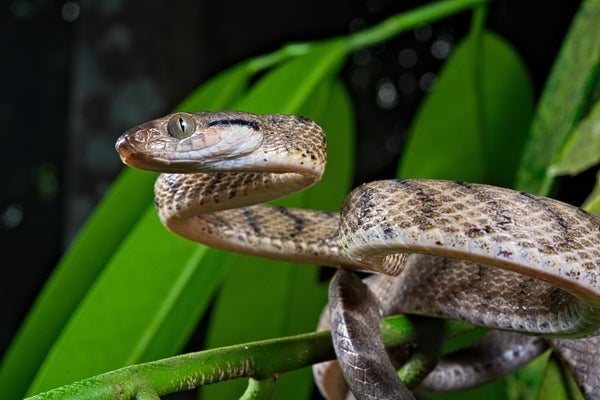
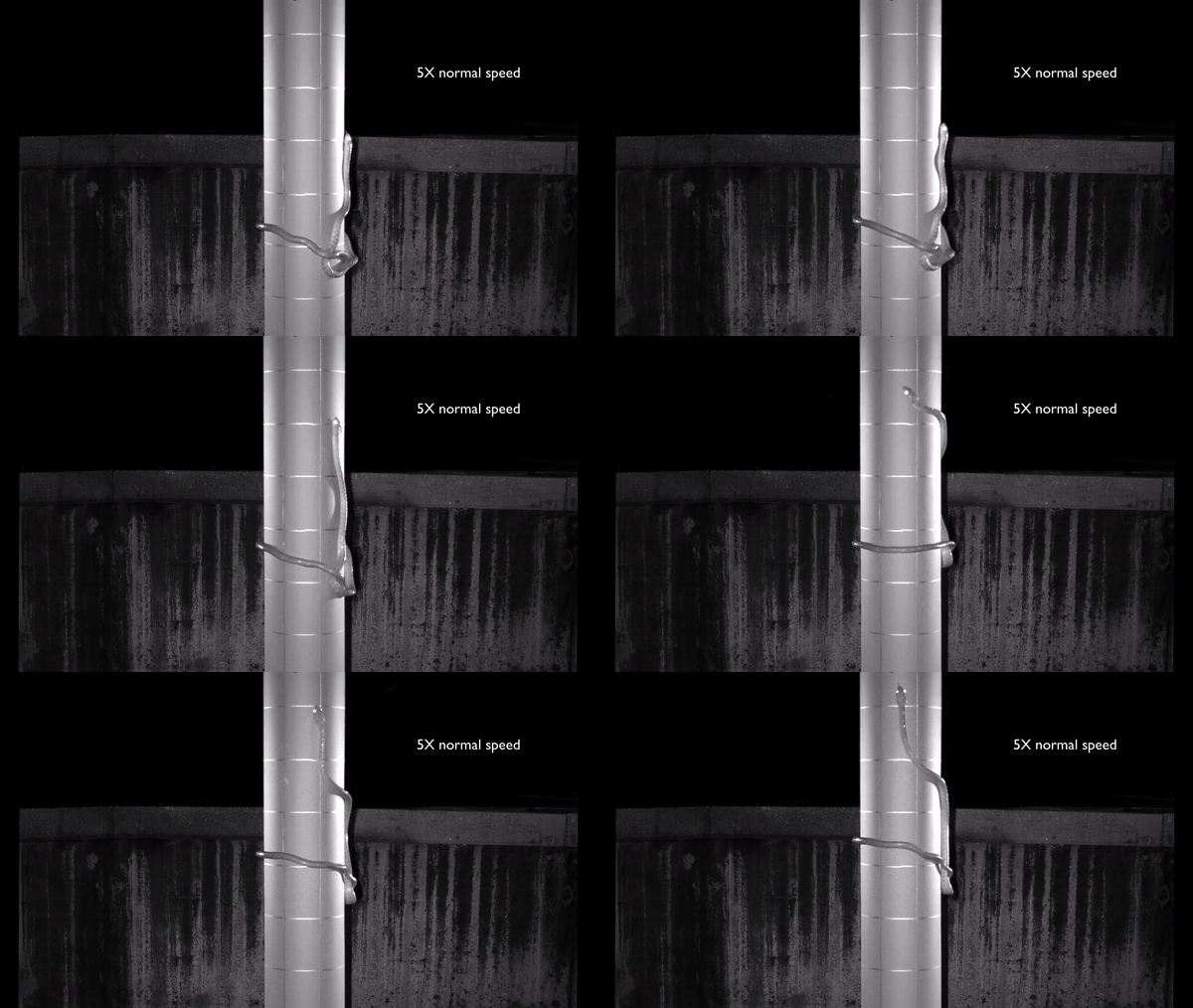
Snakes slither, sidewind and have even been known to launch themselves from one tree to another. Now scientists have discovered another, rather startling form of serpentine movement: brown tree snakes on the island of Guam were observed tying their bodies into the shape of a lasso—and hitching themselves up smooth metal poles.
This “lasso locomotion” is a slow, strenuous process. But researchers say it probably allows snakes to climb wider, smoother trees than they would otherwise be able to scale and to snag prey that might otherwise be out of reach.
Snakes typically climb trees either by tensing their belly muscles to grip tiny projections of bark and then slithering straight up or by a hold-and-release movement called “concertina locomotion.” The latter resembles how a human might climb a rope: The snake grips two spots on a tree with S-shaped bends in its body. It pulls itself up between the two bends, then shifts its hold to ascend higher. The thickness of the tree a snake can climb is limited by the size of the reptile’s body because it needs enough length to grip the tree in two places.
On supporting science journalism
If you're enjoying this article, consider supporting our award-winning journalism by subscribing. By purchasing a subscription you are helping to ensure the future of impactful stories about the discoveries and ideas shaping our world today.
Lasso locomotion is very different, and it works with wider diameters. The snake forms a single loop around a pole (or probably a tree trunk), securing itself by hooking or knotting its tail around its body. It squeezes tight, makes small bends in its body and uses them to creep its way upward, rising like a slow and sinuous elevator. “This lasso locomotion is just from outer space, compared to all of the other variations” in snake movement, says Bruce Jayne, a biologist at the University of Cincinnati and co-author of a new paper reporting this climbing behavior, which was published on Monday in Current Biology.
Credit: Thomas Seibert
Brown tree snakes are a well-studied species, in part because they have devastated local bird populations on Guam after being unintentionally introduced there about 70 years ago. Micronesian starlings (Aplonis opaca) are a favorite meal of brown tree snakes. Julie Savidge of Colorado State University and her colleagues were recently on the island to test barriers, called baffles, for protecting the birds’ nesting boxes. In a recent experiment boxes were set atop narrow poles, which the researchers shielded with wide, slick metal cylinders. But the snakes shocked the scientists by looping themselves into lassos and defeating the barriers. “I’ve been studying the locomotion of snakes on and off for more than 40 years,” Jayne says, “and I was just absolutely stunned.”
“It’s an extraordinary behavioral adaptation,” says David Cundall, a functional morphologist at Lehigh University, who was not involved in the research. It is unclear whether other snake species would be able to pull off the same maneuver, he says. They would most likely have to be long, graceful tree-climbers like the brown tree snakes.
Because the snakes need only one body loop to grip the cylinder in lasso locomotion, as opposed to two for concertina locomotion, they can use the technique to scale cylinders twice as wide. (On Guam, the reptiles themselves are typically three to four feet long, though they can reach up to 10 feet.) Brown tree snakes’ tropical range is populated by many smooth-barked trees, Savidge says, so the snakes may have developed this ability to reach bird nests that are otherwise out of reach. Brown tree snakes outside of Guam have not been observed lassoing their way up trees yet. But, Jayne says, it is likely they can.