
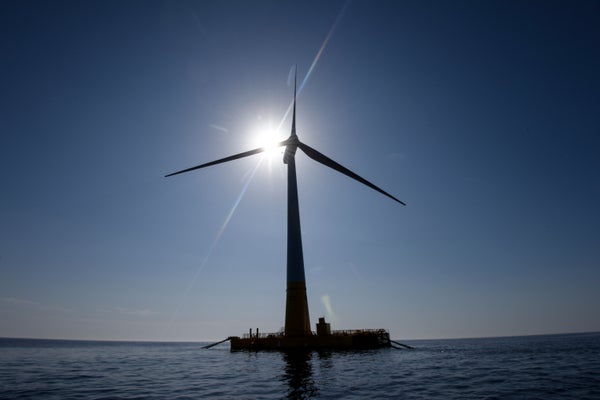
The Energy Department is launching a new contest to lure U.S. companies into the business of designing and building floating wind turbines for offshore areas.
The contest offers a combination of $5.75 million in prizes plus up to $1.1 million worth of assistance from Energy Department laboratories. The goal is to encourage businesses and inventors to design mass-produced platforms called “floaters.”
In doing so, the Biden administration is looking to address a major hurdle in offshore wind energy.
On supporting science journalism
If you're enjoying this article, consider supporting our award-winning journalism by subscribing. By purchasing a subscription you are helping to ensure the future of impactful stories about the discoveries and ideas shaping our world today.
In waters deeper than 200 feet, conventional wind turbines built on foundations extending to the ocean floor become too expensive, said Walter Musial, a principal engineer at DOE’s National Renewable Energy Laboratory (NREL).
That currently blocks wind power from being harvested in about two-thirds of the U.S. offshore areas where turbines could be near population centers, he explained in an interview.
A few oil and gas rigs have been built to operate on platforms that float and are moored by ropes or chains to the bottom in energy-rich areas. “But what oil and gas companies never did was mass-produce their structures. Most every floating oil rig is [a] one-off,” said Musial.
“We want to industrialize this,” he added, noting that some foreign countries are building supply chains capable of producing multiple floating platforms.
The Biden administration and the recently passed Inflation Reduction Act have put premiums on renewable energy projects that produce more American jobs, especially in economically depressed areas, he pointed out. “We want to build supply chains here.”
Deep offshore waters are a barrier to wind energy production along the entire West Coast, the East Coast above Cape Cod and around Hawaii, he noted. And in some areas where there are close-in shallow waters, moving wind turbines farther out would reduce conflicts with fishing companies and with shore dwellers who prize their views.
The aim of the contest, formally called the Floating Offshore Wind Readiness Prize, or FLOWIN, is to help produce about 1,000 15 megawatt floaters with turbines generating roughly enough clean electricity to power about 5 million homes.
The competition will have three phases. The first phase, which closes in mid-January, is designed to attract teams that have ideas for commercial technologies that would reduce the cost of floaters. Up to eight winners would receive $100,000 in cash and move to a second round where each team would develop a pathway for mass production and assembly. Up to five winners would receive $450,000 in cash and vouchers for $100,000 in technical support from Energy Department laboratories.
They would compete in a third phase and develop plans for production and deployment in specific U.S. regions. (Floaters are designed to be assembled in ports and then towed to offshore sites.) Up to three potential winners of the contest each would receive $900,000 in cash.
Reprinted from E&E News with permission from POLITICO, LLC. Copyright 2022. E&E News provides essential news for energy and environment professionals.