
Key concepts
Engineering
Robotics
Vibration
Design
Introduction
Bristlebots are a fun and popular type of robot made from the head of a toothbrush, a small watch battery and a tiny vibrating motor like the kind found in electric toothbrushes. Although these electronic parts can be hard to find around the house, you can still build bristlebots if you make a simple vibrating table instead. This project will show you how to do it—no electronic parts required!
Background
Bristlebots are an easy-to-build version of a type of robot that is more generally called “vibrobots,” meaning they are powered by vibrating motion. Have you ever noticed how a cell phone in vibrate mode will move slightly if it rings while sitting on a tabletop or how you can feel a video game controller rumble in your hands? That happens because these electronic devices have tiny motors inside them with spinning weights. When these weights spin very rapidly, that causes the whole device to vibrate. You can put one of these motors along with a small battery on a toothbrush to make a miniature robot.
On supporting science journalism
If you're enjoying this article, consider supporting our award-winning journalism by subscribing. By purchasing a subscription you are helping to ensure the future of impactful stories about the discoveries and ideas shaping our world today.
Unlike larger robots that usually have some level of “intelligence” and steering, the motion of a bristlebot is random as it bounces around. You can still exert some control over the motion of a bristlebot by adjusting how exactly you build it, however. In this project you will test how using straight or slanted toothbrush bristles can affect the motion of a bristlebot and try to come up with a design that can move faster as well as go straight.
Materials
Two toothbrushes with straight bristles
Two toothbrushes with slanted bristles
Scissors
Ruler
Glue or double-sided foam tape
Medium-size cardboard box, like a cereal box or shoebox
Three wooden pencils
Other assorted craft materials: pipe cleaners, toothpicks, Styrofoam, etcetera (optional)
Preparation
Carefully cut off one of the large sides of your cardboard box.
Cut two smaller squares from another side of the box, about four centimeters on each side.
Have an adult help you cut the heads off all four toothbrushes.
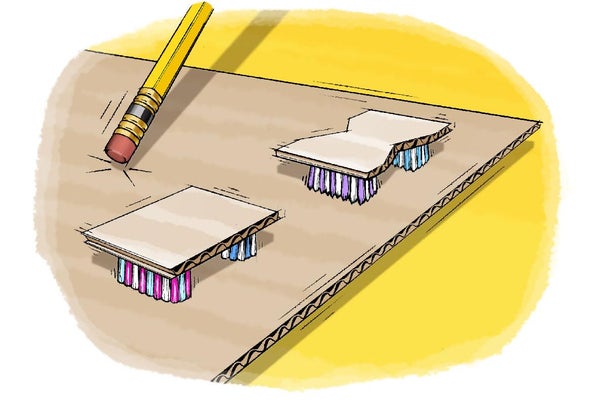
Make your first bristlebot by gluing or taping the two straight toothbrush heads to one of the cardboard squares. Attach the back side of the toothbrush heads to the cardboard so the bristles touch the ground like little legs for your robot. The brush heads should be parallel to each other.
Make a second bristlebot the same way, using the slanted toothbrush heads.
Lay two of your pencils out parallel to each other on a table and place the large piece of cardboard on top of them.
Place both of your bristlebots on one end of the piece of cardboard.
Procedure
Now you are ready to make your bristlebots move! Use the eraser end of the third pencil like a drumstick to rapidly but gently tap the large piece of cardboard to make it vibrate.
How do your bristlebots move? In which direction do they go? Does one of them move faster or go straight better than the other?
Keep tapping the piece of cardboard. Can you get one bristlebot to make it all the way to the other end? Does their motion change if you adjust how hard or how rapidly you tap the cardboard?
Extra: Decorate your bristlebots! Use colored construction paper, add pipe cleaners, googly eyes—but be careful not to add too much weight or it might slow your robots down!
Extra: Think about how you could modify your bristlebot designs. We gave you two very basic designs to get you started but you do not have to use those. You can build a bristlebot out of any craft or household materials you have available. For example, you don't even have to use toothbrushes. What happens if you use toothpicks as legs instead? Can you design and build a bristlebot that goes faster and straighter? See the "RumbleBots" link below for lots of design ideas.
Extra: Cut three more long strips of cardboard and use them to make walls for two parallel racetracks on your large piece of cardboard. This will make it easier to race two different designs together at a time, because the walls will help force the bristlebots to go straight. Ask some friends to build their own bristlebots and race them against one another!
Observations and results
You probably found that your bristlebot with slanted bristles moved faster and went straighter than the one with straight bristles. This is because the bristles are all pointed back in one direction, so when the table vibrates they push the robot forward. One analogy for how this works is ski poles. If you push down on ski poles that are pointing straight up and down, you will not move. If you push down on ski poles that are angled backward, however, you will move forward.
Because this is an engineering design project there is no single “right” answer or way to build the “best” bristlebot. You may be able to come up with your own design that works better than the ones described here. Also, you might have some trouble getting your bristlebots to work at first and will need to make some adjustments. (For example, they might not work very well if the toothbrushes are not parallel.) Do not get discouraged if everything does not work great on the first try, and do not be afraid to try your own new ideas!
This project was inspired by “Race Tiny RumbleBots with a Hand-Cranked Raceway,” by Doug Stith.
The bristlebot concept is from “Bristlebot: A Tiny Directional Vibrobot,” by Evil Mad Scientist Laboratories.
More to explore
Build a Bristlebot, a Tiny Toothbrush Robot, from Science Buddies
Making Sound Waves, from Scientific American
Science Activities for All Ages!, from Science Buddies
This activity brought to you in partnership with Science Buddies
