
Key Concepts
Physics
Forces
Friction
Engineering
Introduction
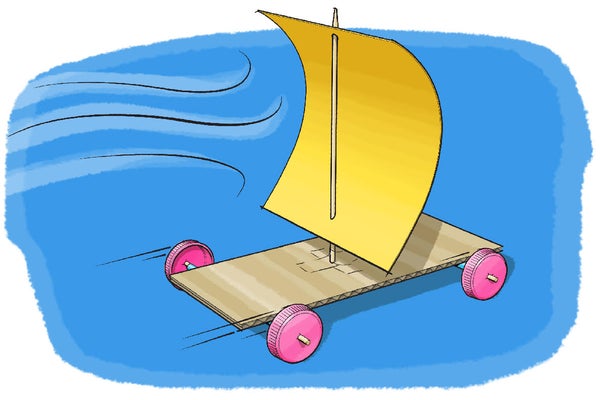
Is that a sailboat or a sail … car? Design and build a toy car powered by the wind in this fun engineering project!
Background
You've probably seen a sailboat at some point—but maybe not a "sailcar." Why don't we have more wind-powered cars? Sailboats must zig-zag back and forth if they want to sail directly into the wind. It probably wouldn't be very safe if we had cars zig-zagging all over the road on a windy day! Although it might not be practical to use a sailcar on the road in real life, building a toy one is a fun engineering project.
On supporting science journalism
If you're enjoying this article, consider supporting our award-winning journalism by subscribing. By purchasing a subscription you are helping to ensure the future of impactful stories about the discoveries and ideas shaping our world today.
When moving air pushes on your car's sail it exerts a force on the sail. This force pushes the car forward. The force, however, must be big enough to overcome any friction in the spinning axles. That friction can be greater if your axles are misaligned or if your wheels are wobbly. You might think you could always make your car go faster by adding a bigger sail. A bigger sail will catch more air, so exert a bigger force, and make the car go faster—right? Not necessarily! A bigger sail is also heavier (it has more mass). It takes more force to move a bigger mass, and a heavier car will also have more friction in its axles. If a sail is too big, it could even make the car so top-heavy that it tips over. What size sail works best? Try this project to find out!
Materials
Corrugated cardboard
Construction paper or cardstock
Three wooden skewers
Two plastic straws
Four plastic bottle caps
Tape
Scissors
Hobby knife
Fan
Long hallway or large room (smooth floors work best)
Adult helper
Preparation
Carefully cut out a piece of cardboard to form the body of your car.
Tape two straws across the bottom of your car, one at each end. Make sure the straws are parallel.
Have an adult use the hobby knife to carefully poke a "+"-shaped hole in the center of each bottle cap.
Push a wooden skewer through the hole in one of the bottle caps (and please push it away from your face!).
Thread the other end of the skewer through one of the straws.
Push a bottle cap onto the end of the skewer opposite the first bottle cap. You just made an axle with two wheels for your car!
Repeat these steps to make the other axle.
Make sure the axles can spin and the car can roll smoothly without getting stuck. If needed, adjust the wheels so they are not too wobbly.
Have an adult use the hobby knife to carefully poke a small hole in the middle of the cardboard.
Insert a wooden skewer upright into the hole to form a mast for your car's sail. Secure it at the base with plenty of tape. If it is still too wobbly, you can build a diagonal support out of a piece of cardboard.
Make at least three sails that are all the same shape but different sizes. For example, for rectangular sails, you could use a whole sheet of paper, a half sheet of paper, and a one-quarter of sheet of paper.
Now you have a sailcar and sails that are ready to test out!
Procedure
Poke the upright skewer through both ends of your smallest sail to hold it in place.
Place your fan on the floor at one end of a long hallway or large room.
Place your car in front of the fan, and turn the fan on. How far does your car go before it stops?
Replace the smallest sail with your next-biggest sail, and try again. How far does your car go this time?
Try with your largest sail. Does the car go as far as you expected?
Extra: Try sails that are different shapes. What shape works the best?
Extra: If you have a variable-speed fan, try the activity on different fan settings. How does the fan speed affect how far or how fast your car goes?
Observations and Results
You might have seen that with the smallest sail, your car started out very slowly. The wind exerts a small force on the small sail, so it may be difficult to overcome friction in the axles so the car can start moving. The car will start more quickly and go farther with a larger sail. There can, however, be diminishing returns with larger sails. Eventually the extra air the sail can catch does not make up for all the added weight of the sail, so continuing to make the sail bigger will not make the car go any farther.
More to Explore
The Physics of Sailing: How Does a Sailboat Move Upwind? from Physics Central
Build a Wind-Powered Car, from Science Buddies
Build a Rubber Band–Powered Car, from Scientific American
Build a Balloon-Powered Car, from Scientific American
STEM Activities for Kids!, from Science Buddies
This activity brought to you in partnership with Science Buddies
