If you're enjoying this article, consider supporting our award-winning journalism by subscribing. By purchasing a subscription you are helping to ensure the future of impactful stories about the discoveries and ideas shaping our world today.
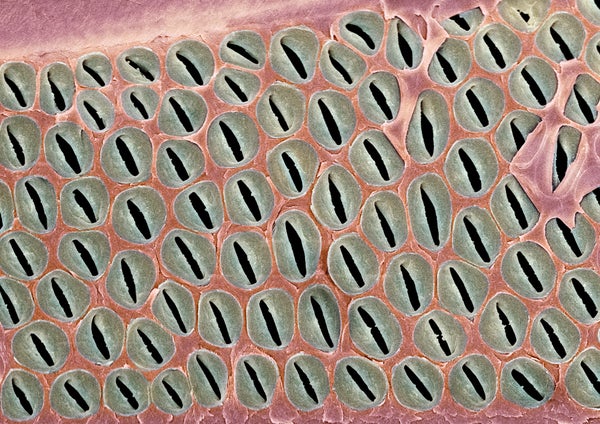
Like all living creatures, plants rely on the transportation of water and minerals throughout their body. Xylem is a vascular tissue that moves substances from plants’ roots to their leaves. Tracheid cells exclusively transport water and minerals, and they are one of several types that make up the xylem in plants cells. This colored scanning electron micrograph shows a bundle of tracheids in a softwood toothpick. Each has a thick lignified, or rigid, cell wall (green), which provides structural support to the stem or plant body. Pits on these tracheids (black) allow water to pass in and out of the cells and into the vascular system. Tracheid cells move water and mineral nutrients from the roots throughout the plant. The image is magnified 1,500 times when it is printed at 10 centimeters wide.
Science in Images is a new category of articles featuring photographs and videos from all the disciplines of science. Click on the button below to see the full collection.
If you enjoyed this article, I’d like to ask for your support. Scientific American has served as an advocate for science and industry for 180 years, and right now may be the most critical moment in that two-century history.
SciAm always educates and delights me, and inspires a sense of awe for our vast, beautiful universe. I hope it does that for you, too.
If you subscribe to Scientific American, you help ensure that our coverage is centered on meaningful research and discovery; that we have the resources to report on the decisions that threaten labs across the U.S.; and that we support both budding and working scientists at a time when the value of science itself too often goes unrecognized.