
February 1968
Nuclear Economics
“Nuclear power, like the boy next door, seems to have grown up overnight. That it has indeed come of age is incontrovertible. For two years running it has accounted for nearly half of all the new power-generating capacity ordered by U.S. utilities. That maturity came quickly is also incontrovertible. The first truly large-scale nuclear unit—a 428,000-kilowatt installation at San Onofre, Calif.—was licensed for construction as recently as February 24, 1964, and announcements of commercial nuclear power projects did not begin to gain momentum until the fall of 1965; yet by the summer of 1966 nuclear power had drawn abreast of fossil power in the utility marketplace. It is safe to say that no one, not even the most optimistic reactor manufacturer, expected so rapid or decisive a market breakthrough.”
On supporting science journalism
If you're enjoying this article, consider supporting our award-winning journalism by subscribing. By purchasing a subscription you are helping to ensure the future of impactful stories about the discoveries and ideas shaping our world today.
February 1918
Auto Export Superpower
“The United States is at present the world's market for motor cars and trucks. An agent for the U.S. Bureau of Foreign and Domestic Commerce reports a prosperous condition of affairs prevailing in Japan, which is buying more automobiles, especially large cars, than ever before. There are about 2,400 automobiles in Japan at present, 600 of which were imported during the first nine months of last year, as against 218 during all of 1916. Japanese roads are very narrow and the bridges weak, but the Government is spending $2,000,000 on the road from Tokio to Yokohama, and has ordered the provinces to improve their roads and bridges.”
High Heels
“Unfortunately the fashion which calls for ever higher heels is as unhygienic as it is unesthetic. By means of the motion picture camera Dr. Édouard Quénu has been able to analyze the constrained gait which results from a heel three inches or more in height. In the film, the subject passes before us in short, jerky steps, moving her foot through the air and putting it on and off the ground quite rigidly, without change of relative position of heel and toe, giving the effect of a stiff and awkward glide rather than a step. It is the jerky progress of an automatic puppet which we have here, not the supple gait worthy of a brisk human being.”
War Balloons
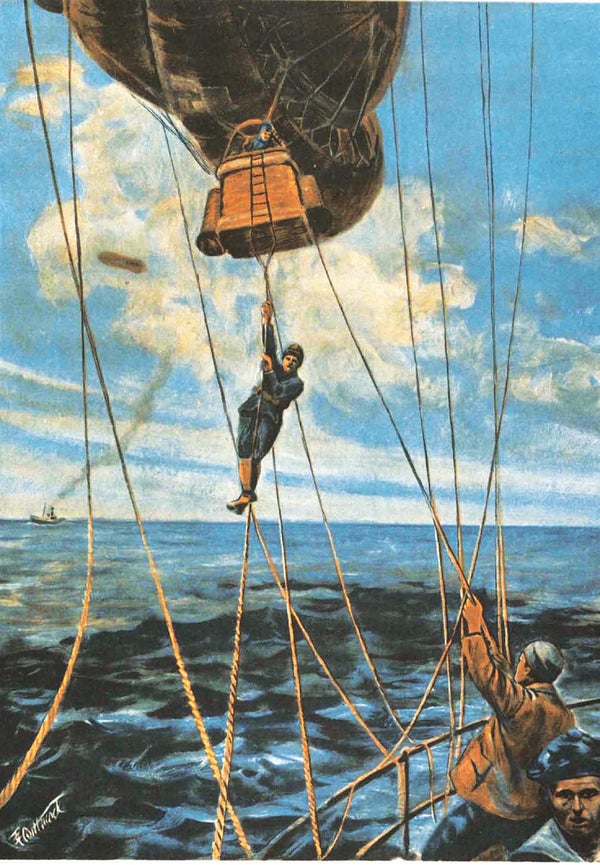
“The French navy is employing a number of kite balloons with tenders for the purpose of spotting German U-boats lurking near the coast and at the entrances of important harbors. The life of a kite observer at sea is full of thrills, especially during those times when he climbs up to the balloon swinging above the trawler [see illustration]. It is said of these kite observers that some of their feats in this connection would compare most favorably with those of a trained tight-rope walker.”
February 1868
Explosive Argument
“An inquest has been held in the latest nitro-glycerin disaster, the explosion at Newcastle, England. The inventor of ‘blasting oil,’ Mr. Alfred Nobel, of Hamburg, writing to the London Times relative to the same Newcastle accident, bitterly complains that the introduction of this valuable explosive, owing to the accidents resulting from gross carelessness, has been systematically opposed. The Newcastle explosion, it seems clear, was caused by the grossest violation of the printed instructions. The cans containing the nitro-glycerin were opened with blows of a spade, and then thrown into a hole one upon another. From the shock thus occasioned the explosion took place.”
A Strict Home
“The New England Farmer, published in Boston, contains every week sensible hints for family rule and life: ‘Don't be afraid of a little fun at home, good people! Don't shut up your house lest the sun should fade your carpets and your hearts; lest a hearty laugh shake down some of the musty old cobwebs there. When once a home is regarded as only a place to eat, drink, and sleep in, the work is begun that ends in gambling houses and reckless degradation. Young people must have fun and relaxation somewhere; if they do not find it at their own hearthstones, it will be sought at other and perhaps less profitable places.’”
