
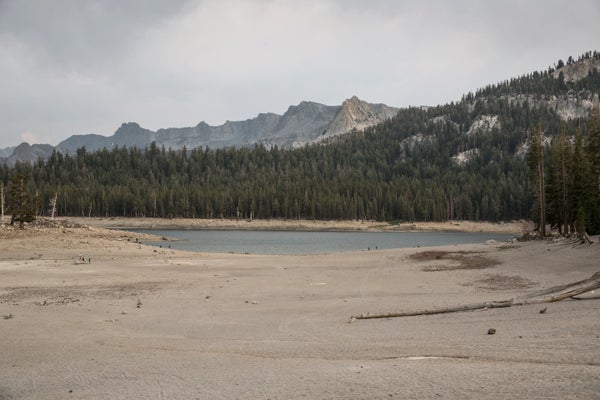
Drought fueled by climate change is transforming California and costing billions of dollars, state officials said yesterday.
California is spending $5.2 billion to upgrade water systems, improve water storage and provide water to parched communities as part of a historic $15 billion spending package to address the effects of climate change.
“Drought is part of California’s natural environment, but is now supercharged by accelerating climate change,” said state Natural Resources Secretary Wade Crowfoot during a virtual meeting with reporters. “Record high temperatures both this winter and spring meant about an 80 percent reduction in the amount of snow and water that flows into our reservoirs, from what we anticipated based on a century of historic records.”
On supporting science journalism
If you're enjoying this article, consider supporting our award-winning journalism by subscribing. By purchasing a subscription you are helping to ensure the future of impactful stories about the discoveries and ideas shaping our world today.
California’s current drought, now in its second year, is roughly equivalent to the driest years ever recorded in California—1976-77.
Newsom has declared a state of emergency in 50 of 58 counties, and officials are asking residents to reduce their water consumption 15 percent. It’s voluntary for now.
Crowfoot and other officials detailed the drought conditions as the state ends what is considers its “water year.” California gets most of its precipitation between October and April, though it’s narrowing now to between November and March.
Relocating fish
The budget money for drought mitigation includes about $1.3 billion for drinking water and wastewater system upgrades, $200 million to expand water recycling and clean groundwater basins, $180 million for groundwater management, $100 million to improve flows in streams and rivers, and $100 million to upgrade water conveyance in parts of the state affected by sinking ground.
California officials yesterday drew a direct link between the drought and climate change. Hotter temperatures accelerated melting snowpack and diminished water supplies throughout the year.
The two-year period of 2020 and 2021 was second only to 1976 and 1977 in terms of low rain and snow.
“But what really happened behind the scenes was the manifestation of these high ambient temperatures and dry soil conditions,” said Karla Nemeth, director of the California Department of Water Resources.
“So while technically 1976 and ‘77 was actually drier than 2020 and 2021, what happened in our reservoirs, rivers and streams” was “actually much lower than what happened in ‘76 and ‘77,” Nemeth said.
Water flow into the Shasta Dam was the lowest ever recorded, and the combined water storage in the state and federal dams at Oroville, Shasta and Folsom are at a record low, she said.
“That is very much driven by increasing ambient temperatures that ... when you look at the historic record used to be exceptional,” Nemeth said. Those now are “very common when you really look at the record starting in about 2010. So that’s the big difference here,” she said.
The extreme heat puts stress not just on California residents but also on the environment, including the state’s iconic chinook salmon, said Crowfoot, pointing to warmer streams.
As a result, the California Department of Fish and Wildlife is relocating native fish and amphibians, and increasing hatchery production to make up for losses of those species.
All areas of the state “will have big problems” if there’s a third dry winter in a row, Crowfoot said.
Reprinted from E&E News with permission from POLITICO, LLC. Copyright 2021. E&E News provides essential news for energy and environment professionals.