
BOULDER, Colo. — Researchers have traced the severe winter droughts that struck California from 2013 to 2015 and this year’s unusually wet winter that caused widespread flooding in the state to the same phenomenon: wavelike patterns of winds in the upper atmosphere that circle the globe.
Two scientists here at the National Center for Atmospheric Research (NCAR) found that a distinctive pattern formed by the wave blocked incoming Pacific storms from coming onshore in the winters of 2013 and 2014, keeping the state unusually dry.
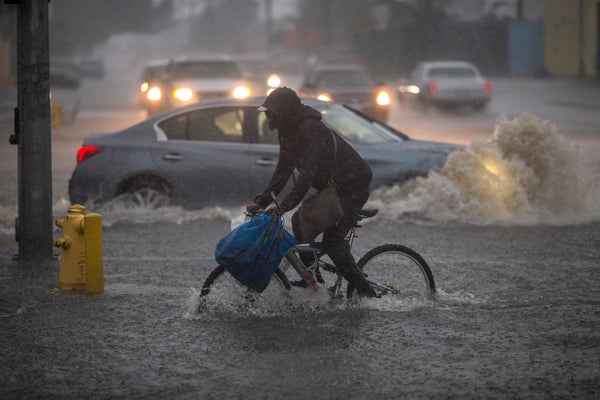
This winter, the same pattern emerged, called “wavenumber-5,” but it was in a slightly different position that allowed the jet stream to push drenching rainstorms into the state, causing flooding and stressing dams.
On supporting science journalism
If you're enjoying this article, consider supporting our award-winning journalism by subscribing. By purchasing a subscription you are helping to ensure the future of impactful stories about the discoveries and ideas shaping our world today.
Haiyan Teng, lead author of the NCAR study, said the wavelike patterns, which consist of five pairs of alternating high- and low-pressure areas, can be associated with the approach of long-lasting extreme weather events.
“As we learn more, this may eventually open a new window into long-term predictability,” Teng said.
NCAR, which is financed in part by the National Science Foundation, has spent several years searching for ways to extend the predicability of floods, droughts, heat waves and other extreme weather events from weeks to months as a way to give weather-sensitive sectors such as agriculture more time to protect themselves against costly losses.
The idea that atmospheric wave patterns might give scientists a better understanding of approaching seasons was first explored by a Swedish-American meteorologist, Carl-Gustaf Arvid Rossby, in 1939. The patterns he identified using early versions of electronic computers are now called Rossby waves. They are caused by the Earth’s rotation, but they can have peculiarly strong impacts on local weather. Some scientists believe that as they meander around the world, their activities can be better weather predictors than variations in sea surface temperatures.
Rossby waves are part of an expensive atmospheric puzzle that has yet to be fully understood. Antonio Busalacchi, president of the University Corporation for Atmospheric Research, which runs NCAR, recently warned Congress that budget cuts contemplated by the Trump administration could “derail” research needed to better predict extreme weather.
He noted recently that last winter’s California flooding and other weather-related disasters cost the United States a total of $15 billion in direct damage.
“Strategic and necessary collaborations among government agencies, academia and the private sector are resulting in landmark progress in short- and long-term forecasts,” he said.
Grant Branstator, another NCAR researcher, noted that sometimes Rossby waves form the classic pattern seen off the coast of California and sometimes they don’t, “indicating that other forces requiring study are also at play.”
One theory is that heat from tropical rain warms parts of the Earth’s upper atmosphere in ways that favor the formation of the classic “wavenumber-5” pattern that has alternately drenched and dried parts of California.
What intrigues scientists is that when it does emerge, the pattern comes about 15 to 20 days before major summertime heat waves hit the United States.
Reprinted from Climatewire with permission from E&E News. E&E provides daily coverage of essential energy and environmental news at www.eenews.net.