
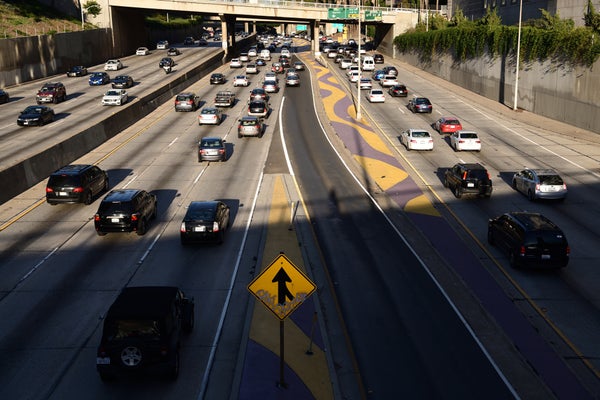
California signaled yesterday it would sue the Trump administration to defend its ability to limit tailpipe pollution. It came a day after the White House abandoned talks with state officials over its plan to scrap the clean car rules.
California Attorney General Xavier Becerra (D) called the White House’s move part of an ongoing “retreat from our nation’s existing Clean Car Standards.”
“Abandoning ship on the U.S.’s serious push to tackle pollution is another sign of impotence and fallibility, something Americans aren’t accustomed to,” Becerra said in a statement. “California and states throughout America are prepared to defend our national Clean Car Standards even if the Trump Administration intends to go AWOL.”
On supporting science journalism
If you're enjoying this article, consider supporting our award-winning journalism by subscribing. By purchasing a subscription you are helping to ensure the future of impactful stories about the discoveries and ideas shaping our world today.
The disagreement comes as clashes escalate between the White House and California officials. Earlier this week, President Trump said his administration would withhold nearly $1 billion in federal funding for a high-speed rail project, part of which was canceled by Gov. Gavin Newsom (D). Then the White House broke off talks about the clean car rules, signaling its intention to strip California of its ability to impose the toughest pollution limits in the nation.
Thirteen other states adhere to California’s tougher rules limiting greenhouse gas emissions from cars. The state has a waiver allowed under the Clean Air Act that lets it set stronger standards than the federal government.
Trump said yesterday that the Department of Transportation and EPA will cease discussions with the California Air Resources Board (CARB) over the state’s clean car standards and will push ahead with a plan to weaken the Obama-era regulation.
“Despite the Administration’s best efforts to reach a common-sense solution, it is time to acknowledge that CARB has failed to put forward a productive alternative,” the White House said in a statement. “Accordingly, the Administration is moving forward to finalize a rule later this year with the goal of promoting safer, cleaner and more affordable vehicles.”
The Obama administration, along with California and automakers, agreed that cars must reach 54.5 mpg by 2025 (or about 36 mpg in real-world settings). The Trump EPA and the National Highway Traffic Safety Administration want to freeze the standard at 2020 levels through 2026. The Trump administration also proposed yanking California’s Clean Air Act waiver.
Congress allocated $3.5 billion for the planned bullet train in 2009, spending authorized by the American Recovery and Reinvestment Act.
Trump’s Department of Transportation said it would attempt to revoke $929 million not yet provided, after Newsom said he’ll limit bullet train construction to a segment in the state’s Central Valley due to a lack of money.
That train approved by Golden State voters in 2008 was supposed to connect San Francisco and Los Angeles. Newsom’s office said more federal funds or private dollars would be needed to build the longer route.
Newsom in a tweet called ending negotiations on clean car standards “another targeted attack on CA by the Trump administration.”
“President Trump is now targeting clean, breathable air for kids across America in his quest to punish California,” Newsom said in a separate statement. “The science is clear—increased fuel standards save children’s lives, and even automakers have lobbied to preserve our stronger air standards. If the Trump Administration follows through, the only winners will be fossil fuel companies, and those profits will come at the expense of our children’s health.”
The Trump administration’s move could hurt California’s efforts to limit climate change.
“We have not seen the final federal proposal,” CARB spokesman Dave Clegern said in an email. “But if they follow through and freeze the standards completely for model year 2021-2025 vehicles at 2020 emission levels, global warming emissions could increase by almost 14 million metric tons (MMT) per year by 2025.”
That’s roughly equivalent to putting an additional 2.8 million cars on state roads for a year, Clegern said.
“Air pollutants such as nitrogen oxides (NOX) in the state could increase beyond 2020 levels by more than 3,600 tons annually,” Clegern said. “Californians are already living with severe impacts of climate change in the form of increasingly frequent and severe wildfires, extended drought, and rising sea levels.”
CARB Chairwoman Mary Nichols said in a statement that the Trump administration’s decision “is a signal to us to stand our ground and resolutely defend standards that clean the air we breathe, fight climate change and provide certainty to carmakers in a global market moving inexorably toward cleaner, more efficient cars.”
Sen. Kamala Harris (D-Calif.)—one of many Democrats seeking to challenge Trump for re-election in 2020—called the administration’s move an attack on the state.
“The administration’s decision follows a troubling pattern of targeting the state of California for political purposes,” she said.
“Every American deserves the ability to breathe clean air and drink clean water,” Harris added. “California has long led the nation in setting emissions standards that will improve air quality, combat climate change and reduce our reliance on fossil fuels.”
Reprinted from Climatewire with permission from E&E News. E&E provides daily coverage of essential energy and environmental news at www.eenews.net.