

Mantis shrimp hold the title for the fastest punch in the animal kingdom—powerful enough to break seashells and aquarium glass. They also boast some of the world’s most complex, extraordinary eyes. Human eyes have three kinds of light receptor cells, but these shrimp have a dozen, allowing them to sense properties of light invisible to other animals.
Engineers at the University of Illinois at Urbana-Champaign have now made a camera that closely copies the crustacean’s impressive visual system. The device, described last October in Optica, is a one-inch cube, and researchers say it could be made in bulk for $10 apiece. They believe it could ultimately be used to help cars detect hazards, to let military drones see camouflaged or shadowed targets, and to enable surgeons to perform more accurately.
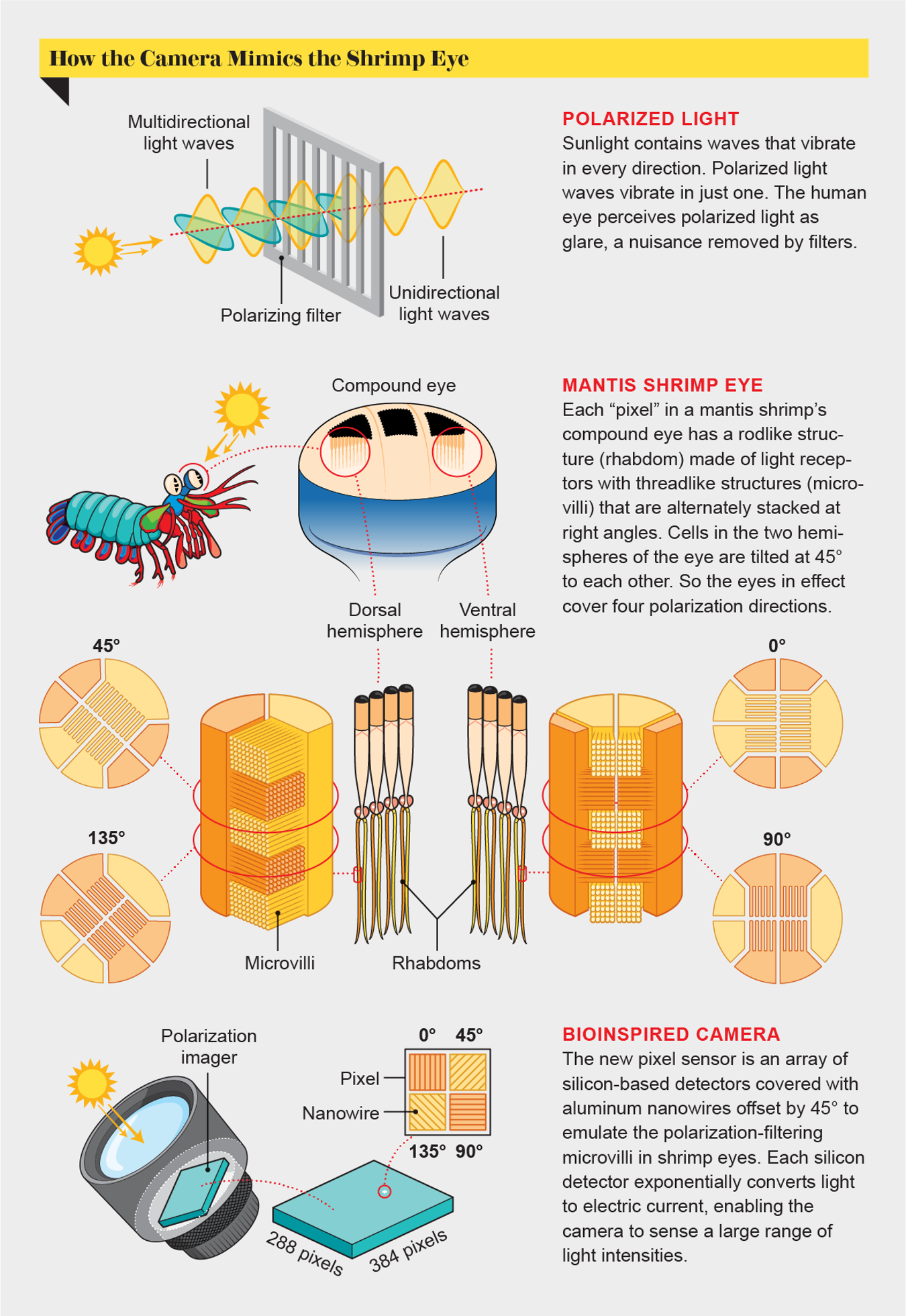
Credit: Brown Bird Design; Source: “Bioinspired Polarization Imager with High Dynamic Range,” by Missael Garcia et al., in Optica, Vol. 5, No. 10; October 20, 2018
On supporting science journalism
If you're enjoying this article, consider supporting our award-winning journalism by subscribing. By purchasing a subscription you are helping to ensure the future of impactful stories about the discoveries and ideas shaping our world today.
Mantis shrimp have two visual superpowers. For one, they can sense “polarized” light, in which all the waves undulate in the same plane (unpolarized light vibrates in every direction). Light bouncing off objects always contains a polarized component, and this property of light can reveal objects that otherwise blend into the background; mantis shrimp use it to find prey in their blue-tinged ocean environs. They can also detect an extensive span of light intensities known as dynamic range, which lets them see very bright and dark areas at once.
The new camera emulates both abilities. Electrical and computer engineer Viktor Gruev and his colleagues made an array of tiny, silicon-based light detectors similar to those found in commercial polarization cameras. But whereas conventional detectors produce an electric current that increases linearly with light intensity, the new detectors respond exponentially. This yields a dynamic range about 10,000 times higher than today’s commercial cameras. The researchers also covered the detectors with microscopic aluminum wires to imitate microvilli, the tubular structures in shrimp eyes that filter and sense polarized light.
For a real-world test, the team drove around in a car mounted with their new camera and a standard one. Pictures from the shrimp-eye camera had much higher contrast, especially in foggy and rainy conditions and in scenes with a lot of light and shadows, Gruev says.
The mantis shrimp is the only creature that can sense a full spectrum of colors and polarization, says Thomas Cronin, a professor of biological sciences at the University of Maryland, Baltimore County, who was not involved in the study. This characteristic makes it ideal for a camera to emulate, he says: “You would get clear images of objects in a complicated background that are difficult to pick out with other techniques.”
