
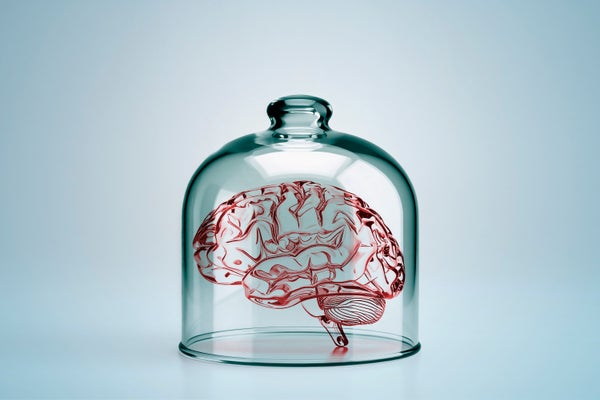
What would it feel like to be a brain in a vat? If you had no body and no world in which to ground yourself, could you be conscious of anything at all?
Neuroscientists and philosophers have debated this thought experiment for decades as they have tried to understand how the three-pound organ in our heads can generate something as lofty as consciousness: an individual’s feelings, thoughts and subjective sense of self. Your current conscious experience is likely dominated by the feeling of your body and the world around you—this is the case much of the time. But researchers like thinking about extreme cases to sharpen their theories about how consciousness works. So, they ask, can consciousness exist without these interactions with the outside world?
“Are they necessary in a deeper way? Are they necessary for any kind of consciousness at all?” asks Anil Seth, a neuroscientist at the University of Sussex in England. There are reasons to believe that consciousness could exist without a body and external world. Scientists know, for example, that some strange form of consciousness persists during dreaming despite the brain being mostly cut off from the world.
On supporting science journalism
If you're enjoying this article, consider supporting our award-winning journalism by subscribing. By purchasing a subscription you are helping to ensure the future of impactful stories about the discoveries and ideas shaping our world today.
So why wouldn’t a brain in a vat be conscious? In the past few years, scientists have attempted to put this thought experiment to the test by studying people who have had a rare brain surgery called a hemispherotomy. Children and adolescents who experience severe, largely untreatable epilepsy may undergo this procedure, which severs half of the brain, isolating it—and its seizures—from the rest of the brain and the outside world while keeping its blood flow and nutrient supply intact. Until recently researchers had little idea what happened to that severed part of the brain. Did it go dark entirely, or did it somehow maintain its own strange form of disconnected consciousness—an “island of awareness,” as scholars call it?
New studies now suggest that brain networks in the isolated hemisphere remain surprisingly intact, but it likely enters a strange form of deep sleep. Though these results can’t prove whether or not this brain region is conscious, they offer clues about the importance of brain waves that arise when part of the brain is disconnected.
The Isolated Half
The two hemispheres of the human brain are mostly mirror images of each other. Each controls and receives signals from the opposite side of the body, and information constantly zings between the two halves.
But certain disorders, often brought on by brain injury in childhood, can cause dozens of seizures a day to arise in one of the hemispheres. These storms of electrical activity wreak havoc on both halves of the brain and can be devastating to people’s lives. If they can’t be treated with medication, the best course of action may be to remove the seizure-prone hemisphere from the picture—either by taking it out entirely (called a hemispherectomy) or by cutting its connections to the rest of the brain (called a hemispherotomy). In hemispherotomy, the disconnected hemisphere can no longer receive sensory input or send output to control the body. When the procedure is done early enough in life, people can make a good recovery thanks to the brain’s phenomenal flexibility.
But there’s “very little, if anything, known about what happens in the [disconnected] hemisphere itself,” Seth says. The possibilities fall on a spectrum with two extremes. Perhaps the isolated hemisphere goes silent or its neural activity devolves into randomness, without any meaningful communication between brain regions. Or maybe it remains entirely intact, separated from the other half of the brain and the rest of the body but still conscious. “Philosophically that would be the more problematic case,” says Tobias Bauer, who studies epilepsy at University Hospital Bonn in Germany. “You have two functioning brains, [and that] will include a second personality, a second experience, a second everything.” Any consciousness that might be maintained would be totally cut off from the world. “I always imagined that if there is something, then it would probably feel, maybe, like dreaming,” says Theodor Rüber, also of the University Hospital Bonn.
To peer inside these severed brain halves, researchers began by using an imaging technique called functional magnetic resonance imaging (fMRI), which tracks blood flow to estimate which brain regions are consuming energy. In a 2020 study of two young people who had undergone hemispherotomies, researchers found something unexpected: Brain activity in the isolated hemisphere was still organized into the same brain networks that are present in a healthy hemisphere.
“The surprising part was the networks,” says Athena Demertzi, a researcher at the University of Liège in Belgium, who co-led the study. “It was like, how is that possible?” You would expect the isolated hemisphere to have no activity or random activity, she says. But whatever was happening on this isolated “island,” it was not random.
A more recent study, which was posted in 2024 as a preprint and has not yet undergone peer review, found similar results. Rüber and Brauer analyzed fMRI scans from 26 people who had undergone a hemispherotomy as many as 19 years prior. They found that all seven of the brain’s core networks still appeared to be active in the isolated hemisphere. These networks are normally connected to each other and organized in a sort of hierarchy, moving from more specific tasks such as processing visual stimuli to higher-order, abstract ones. The default mode network, for example, is a higher-order network that is known to be active when someone is daydreaming, planning or thinking about themselves. The hierarchical organization between different networks was also preserved, the researchers found. “The very general interpretation would be that everything that we found is surprisingly normal in the isolated brain hemispheres,” Bauer says.
(Dis)proving Consciousness
These preserved networks do not mean that the isolated hemisphere is an “island of awareness,” however. Brain networks don't disappear when we lose consciousness during deep sleep or while under anesthesia; their connectivity may change, but the networks are still broadly preserved. In addition, fMRI has an important limitation: it only measures blood flow. Although blood usually flows to areas where neurons are active, it still isn’t a direct measure of the brain’s electrical activity.
To measure such activity itself, researchers used electroencephalography (EEG): electrode caps that detect brain waves from outside of the scalp. In a study published in October 2025, researchers recruited 10 children who were about to undergo hemispherotomy. They measured the brain’s background EEG activity in both hemispheres before and after surgery, with an average of 20 months in between.
What they found were isolated hemispheres dominated by slow waves—“the hallmark of deep sleep,” says Marcello Massimini, senior author of the study and a neurophysiologist at the University of Milan. These waves of electricity ripple across the brain a few times per second as neurons rhythmically cycle between two electric states. Slow waves tend to indicate unconsciousness, or dreamless sleep, which would suggest that the isolated hemisphere might be unconscious, too.
But this conclusion isn’t entirely solid. “Slow waves can be used as a proxy for unconsciousness, but that’s not watertight,” Massimini says. In the last five to 10 years, scientists have discovered that slow waves can also appear during consciousness, including during psychedelic trips, during sedation and deep sleep, as well as in a rare genetic condition called Angelman syndrome that causes developmental delays. Given that hemispherotomy is already exceptional, the presence of slow waves alone isn’t enough to conclude the isolated hemisphere is unconscious.
This state is also unlike anything one would see in a healthy, connected brain. “You can’t really say it’s ‘sleep,’” says Seth, a co-author of the EEG study. “Sleep is not simple... It’s very carefully orchestrated.” One of the main orchestrators of sleep is the thalamus, a deep-brain structure from which the isolated hemisphere is entirely cut off. This disconnect means that the isolated hemisphere’s activity lacks important features of sleep, such as “spindles” generated by the thalamus that appear as quick bursts on EEG and promote memory processing during sleep.
The most sensible interpretation of these data, Seth says, is that the isolated hemisphere is in a state of absent or diminished consciousness. In other words, it’s likely not an island of awareness. But neither does this part of the brain stop working entirely. “The brain could even go silent—we didn’t know,” Massimini says. “But it keeps working, with this sleeplike regime.”
Massimini frequently studies sleep and slow waves, and he finds it fascinating that the brain seems to default to this pattern of activity in the absence of external stimulation. Similar patterns are sometimes seen after a stroke, when slow waves intrude upon damaged parts of the brain. “Every time the cortex is disconnected, that’s what it does,” he says, calling it a “default state.”
The Next Frontier
It remains an open question whether a connection to the outside environment is required for consciousness. “I’m tempted by the idea that, in principle, you could perhaps get a brain that is a complete island of awareness,” says Timothy Bayne, a philosopher of mind at Monash University in Australia and a co-author of the EEG study. Yet many researchers believe that consciousness evolved to allow moving organisms to process and interact with their environment. “That suggests a deep, deep connection between consciousness and input and behavioral control,” Bayne says.
What about systems that didn’t evolve like the human brain? Researchers are already growing tiny models of human brains out of neurons in the lab. These brain organoids are still quite rudimentary, but research on them is advancing at a rapid pace. Could a lab-grown organ that has never “seen” daylight or been connected to a body gain consciousness? What about artificial systems, such as AI models? While most scientists think brain organoids and AI are not nearing consciousness yet, researchers are still trying to agree on how to detect it in such strange systems.
For Massimini, the case of hemispherotomy illustrates the importance of having tests for consciousness that don’t rely on external behaviors of a system—like an AI claiming it is sentient—but that peer under the hood to test how they operate. We cannot rely on external signals to determine consciousness of an isolated brain hemisphere; neither can we rely on it to tell whether someone who is unresponsive after a brain injury is conscious or to determine if an AI model that claims to be sentient actually has a sense of self. “You cannot judge consciousness by behavior. You cannot judge being by doing,” he says. “You need to go deeper.”