
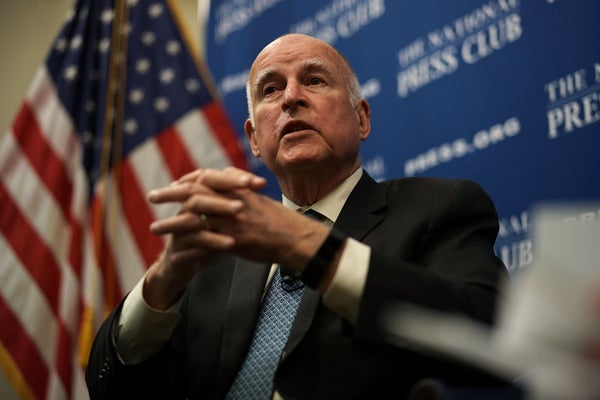
California's entire economy should go "carbon neutral" by 2045, Gov. Jerry Brown (D) said in an executive order that aims to hit the most ambitious climate target in the nation.
Some experts said the order is purely aspirational, as it doesn't include any mandates. Others said it tells state agencies to make it happen. As well, it leaves open the possibility of future technological developments, they said.
"It's going to create momentum toward that end goal, even if it doesn't specify how to achieve that end goal," said Tim O'Connor, senior director of Environmental Defense Fund's energy program in California. "Setting the policy and the vision, especially on something where we've got a 27-year runway, is the first step in achieving that final result."
On supporting science journalism
If you're enjoying this article, consider supporting our award-winning journalism by subscribing. By purchasing a subscription you are helping to ensure the future of impactful stories about the discoveries and ideas shaping our world today.
Brown issued the executive order as he signed into law S.B. 100, which requires the state to reach "zero-carbon" electricity by 2045.
The executive order came at the start of Brown's Global Climate Action Summit in San Francisco. The timing was likely a political signal, meant to encourage states and businesses to pledge action on climate, observers said.
"Climate change is causing historic droughts, devastating wildfires, torrential storms, extreme heat, the death of millions of trees, billions of dollars in property damage and threats to human health and food supplies," Brown said in the executive order. Scientists agree, he said, that carbon neutrality "must be achieved by midcentury."
The order tells the California Air Resources Board (CARB) to work with state agencies to develop a framework toward the goal. CARB, the California Natural Resources Agency, the California EPA and the state Department of Food and Agriculture were told to create sequestration targets toward carbon neutrality in their future plans.
The fact that the executive order is not a mandate means the state Legislature would likely have to approve programs to make it work. Moreover, a future governor could change it. Brown's term ends this year.
The Republican candidate for governor gave it some backing.
"It's a pretty laudable goal," candidate John Cox said in a statement. "I support it, but the question is can we get there, and for that, time will have to tell."
Democratic candidate Gavin Newsom, the current lieutenant governor, did not immediately respond to a request for comment.
Public perceptions about climate change could shift in the coming years, creating more demand for action, said Robert Stavins, a professor of energy and economic development at Harvard University. If extreme weather events like hurricanes and wildfires are increasingly seen as threats "that could really change the political picture," he said.
Stavins noted that the several major environmental laws were passed after the perception of a crisis. The Clean Water Act followed fires on the Cuyahoga River in Ohio in 1969. The Clean Air Act followed concerns about air pollution from steel mills.
"Political change and technology change" will influence Brown's goal, and "whether or not that turns out to be realistic," Stavins said.
Shifting cars and trucks
The biggest obstacle stands to be transforming transportation, which accounts for 40 percent of greenhouse gas emissions in California, said O'Connor, with EDF. Electric vehicles currently comprise about 6 percent of cars in the Golden State.
"In order to meet this goal you're going to need to bend the curve on transportation," he said.
The oil industry pushed back on earlier attempts to mandate cuts in petroleum use in the state. S.B. 350, which passed in 2015, raised the state's electricity renewables mandate to 50 percent by 2030. An earlier version contained language ordering a 50 percent cut in petroleum use. That was stripped out because of pushback from the oil industry.
"The resolve of the next administration on taking steps to combat climate change through deep carbon reductions is certainly going to be tested by the fossil fuel industry," O'Connor said.
Catherine Reheis-Boyd, president of oil trade group Western States Petroleum Association (WSPA), said to reach carbon-neutrality "or any of California's ambitious climate change goals, we must be able to have real discussions about a sustainable energy future. Any realistic view of the future includes our industry, our innovative employees, and the products we provide that power the state."
There's currently a push in California toward electrification of homes, and phasing out natural gas, O'Connor said. Sacramento's municipal utility is giving $11,000 to each household that switches from gas to electric, he said.
Michael Wara, director of the Climate and Energy Policy Program at the Woods Institute for the Environment at Stanford University, said eliminating carbon in the agriculture and industrial sectors will be "super tough."
Agriculture right now is used to subsidies, not mandates, he said.
Wara said it's relevant that Brown made the goal carbon neutrality and not zero carbon.
Carbon neutrality allows for offsets, such as investing in programs to prevent deforestation. It's similar to what's allowed under the state's cap-and-trade program, which forces businesses with high emissions to purchase environmental permits for that pollution.
"Those words were chosen very carefully," Wara said of carbon neutrality. "If they had said zero carbon ... then people could legitimately scoff and say we're not going to get to zero carbon."
Reprinted from Climatewire with permission from E&E News. E&E provides daily coverage of essential energy and environmental news at www.eenews.net.