
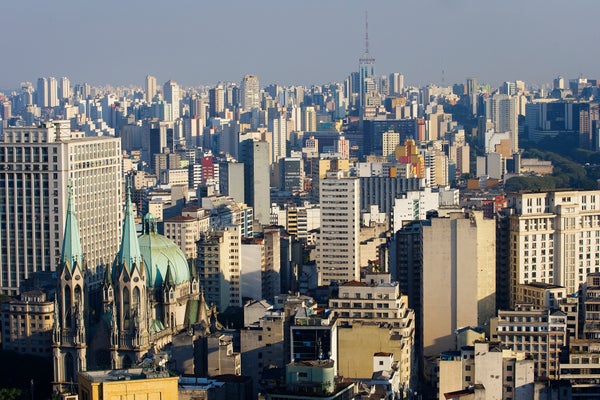
In a rapidly urbanizing world, cities have become a hot spot for climate action. As urban communities expand, urban planners must increasingly play the role of climate change problem solvers, experts said yesterday.
Currently, more than 3.5 billion people live in cities, according to the World Bank. That number is expected to reach 5 billion by 2030, with two-thirds of the global population living in cities.
The adverse health and environmental effects of urban sprawl will become even more pressing as urban populations grow and their greenhouse gas emissions increase, researchers say. In response, cities need to become more vigilant.
On supporting science journalism
If you're enjoying this article, consider supporting our award-winning journalism by subscribing. By purchasing a subscription you are helping to ensure the future of impactful stories about the discoveries and ideas shaping our world today.
“Sustainable cities will set important limits—so, for example, we’re not going to use fossil fuels in an unlimited kind of way,” Gary Gardner, director of publications at the Worldwatch Institute, said at a panel discussion the environmental think tank hosted yesterday.
Cities are often the drivers of climate change, but they are also its victims and potential remediators, said Tom Prugh, senior researcher at Worldwatch.
As it expands, the city becomes a driver and urban sprawl eats up forested lands. That in turn leads to deforestation, which accounts for roughly 10 percent of global greenhouse gas emissions.
In its position as victim, the city succumbs to climate-caused disasters, he said, pointing to the devastation in New York City caused by Superstorm Sandy. Eight of 10 of the biggest cities lie on coasts, making them especially vulnerable to rising sea levels, said Prugh.
“We have a long, tough climb ahead” when it comes to making cities more sustainable, Prugh said.
But developing cities have a big say in their own shape and environmental stance, as well as their CO2 output, said Michael Renner, Prugh’s colleague at Worldwatch. Much of this, he said, comes down to their layout.
For instance, Atlanta and Barcelona, Spain, are similar in size, with roughly 5 million people each. But they are vastly different in how far each city sprawls—and how much gasoline residents use to get around. That usage makes a marked difference in emissions.
In the United States and Canada, sprawl is among planners’ fundamental challenges. It encourages high energy use and dependence on automobiles, experts said.
Some cities, like Aspen, Colo.—which gets 100 percent of its electricity from renewable sources—have achieved success in their greening efforts. The next step lies not in buildings, experts said, but in people.
But a sustainable city is also a socially inclusive one. In other words, ensuring a city is green means making sure all of its inhabitants have access to items like efficient appliances and clean energy, Renner said.
“Green” can’t just be a status symbol, he said.
“Social inclusion is a must,” Renner said. “This has to work for everyone, otherwise it’s just not enough.”
Reprinted from Climatewire with permission from Environment & Energy Publishing, LLC. www.eenews.net, 202-628-6500
